Why spend an extra night in southwestern Uganda?
The main reason is that there is more to see and do here than gorilla trekking alone. Think, for example, of the beautiful Lake Mutanda, Lake Bunyonyi, a visit to the Batwa, a walk in the area around your lodge, or golden monkey trekking in Mgahinga or challenging day hikes on the Virunga Volcanoes. And perhaps, after the gorilla trek, you just want to do absolutely nothing. Enjoy a nice lunch, take in the view, and quietly let the morning’s experiences sink in.
With three nights, you have the space for this without constantly being on the move. The choice of accommodation also plays an important role in this. We look not only at the distance to the starting point of the trek, but also at the surroundings and what else you can do during your stay. Below, we describe some of our favourite activities in the region:
Hike from Buhoma to Nkuringo
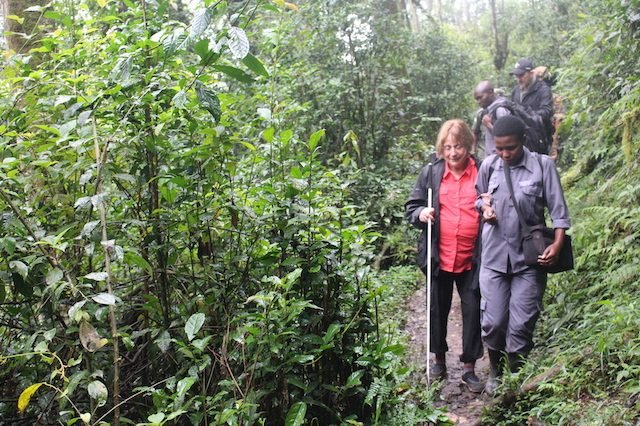
Bwindi Impenetrable Forest has four gorilla trekking sectors: Buhoma in the north, Ruhija in the east, and Rushaga and Nkuringo in the south. Choosing the right sector is more important than many travellers realise beforehand. Your trekking sector is determined when you book your gorilla permit. And there is no road through the forest connecting the four sectors. However, there are a few hiking trails that cut through the forest. The longest and best-known of these is the 6-hour Ivy Trail, which connects Buhoma in the north with Nkuringo in the south. You start at the ranger post in Buhoma. From there, you walk into the park with rangers and porters. You will encounter waterfalls. You will cross rivers. And if you’re lucky, you might have an unexpected encounter with the King of the Jungle, that is the mountain gorilla! You continue walking to Nkuringo in the south– where you will be picked up again. It is an activity that few tourists do. So, if you want to spend more time in Bwindi, this is a beautiful, unique experience.
Climb a volcano
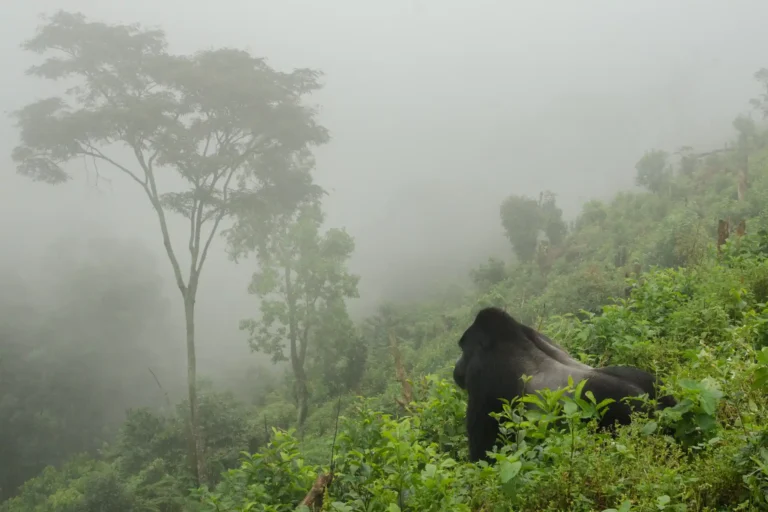
Mgahinga Gorilla National Park is about a 1.5-hour drive from the Rushaga sector of Bwindi. The park is home to three volcanoes, all of which you can climb. The most popular is Mount Sabyinyo, which you can climb and descend in a single day. It is a challenging hike. But naturally, a ranger and porters accompany you to help you on your way. The hikes are tough because you gain a lot of altitude in a short amount of time. But the effort is worth it. The reward is great. Once you reach the summit of the volcano and the sky opens up, you look out over Congo, Rwanda, and Uganda. It is quite special to stand on a mountain that brings these three countries together.
Golden Monkey Trekking
Mgahinga Gorilla National Park is also the place in Uganda where you can visit endangered golden monkeys. These unique monkeys are found only in the Virunga Mountains. These unique monkeys are found only in the Virunga Mountains. They are medium-sized with a distinctive golden-orange coat and a cuddly appearance. They are interesting and fun to see. If you find the gorillas too expensive, the golden monkeys are a good alternative. It is over 700 dollars cheaper. If you want to see both gorillas and golden monkeys, we often find it wonderful to do the gorilla trekking in Bwindi Impenetrable Forest and then visit Mgahinga for the golden monkeys. This way, you experience two different national parks and landscapes.
Visiting the Batwa
Originally, Mgahinga and Bwindi were the territories of the ‘Batwa’ – a tribe of hunter-gatherers who lived these forests for centuries. They are no longer allowed to live in the national parks, so they live in communities around them. If you wish, you can visit them and learn about their traditional way of life. There is the Batwa trail in Mgahinga and Buniga Forest Walk in Nkuringo. On both visits, you set out with people from the community. They show you how they traditionally lived, how they hunted and prepared food. They also demonstrate how they shoot with a bow and arrow. The story of the Batwa is a sad one: after all, they had to give up their ancestral homeland and can no longer live as they did before. Because of this, a visit can feel bittersweet. Nevertheless, it is a special opportunity to learn about their history and culture.
Water sports Lake Mutanda
From Mutanda Lake Resort, near the Rushaga sector of Bwindi, you can enjoy various water activities on Lake Mutanda. You can take a refreshing swim in this bilharzia-free lake or sunbathe on one of the three swimming jetties. If you want to be a little more active, you can use the stand-up paddleboards, kayaks or Laser sailboat. For a more local experience, you can also go canoeing in one of the traditional dugout canoes. There is also a motorboat available for a trip across the lake. You can use it to spot birds or simply enjoy the beautiful surroundings with your favourite drink. Whatever you choose, take some time to enjoy the scenery and peaceful atmosphere of Lake Mutanda.
Cooking class in Buhoma
During the cooking class, you will get to know traditional dishes from the Bakiga culture. You start by gathering fresh vegetables and herbs from the garden at Ride 4 a Woman. Afterwards, you head to the kitchen and prepare the dishes together with the chef. You will learn to prepare local favourites such as matoke, groundnut sauce, roasted goat meat and various vegetable dishes, including sukuma wiki (local spinach). You will also get to try Imonda, a traditional drink made from sorghum, millet, honey and water. In the evening, you enjoy the dishes you have prepared around a campfire, together with the women and families involved in the cooking class. The proceeds from the activity go directly towards supporting the Ride 4 a Woman initiative.
Meet the Gorilla Doctors
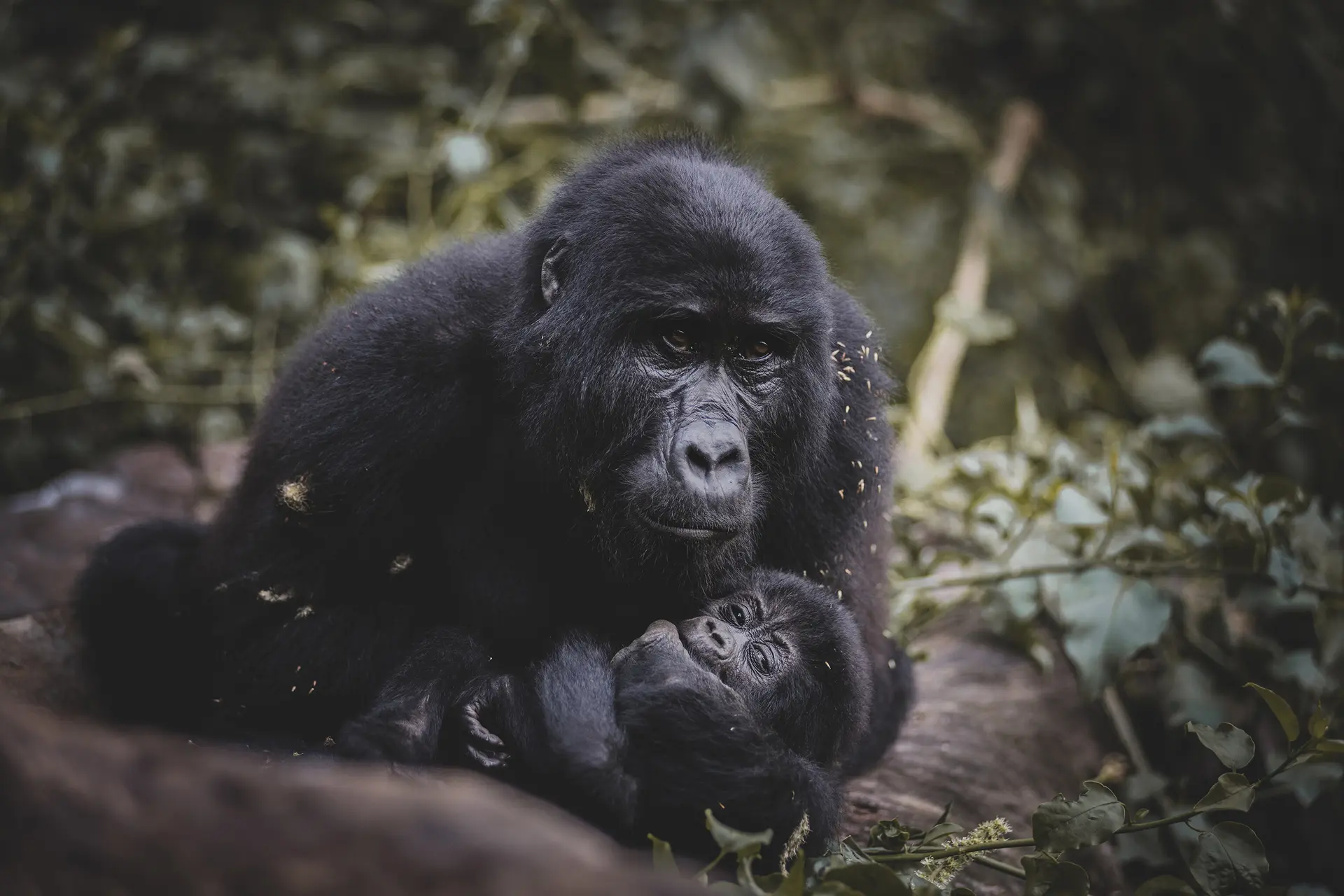
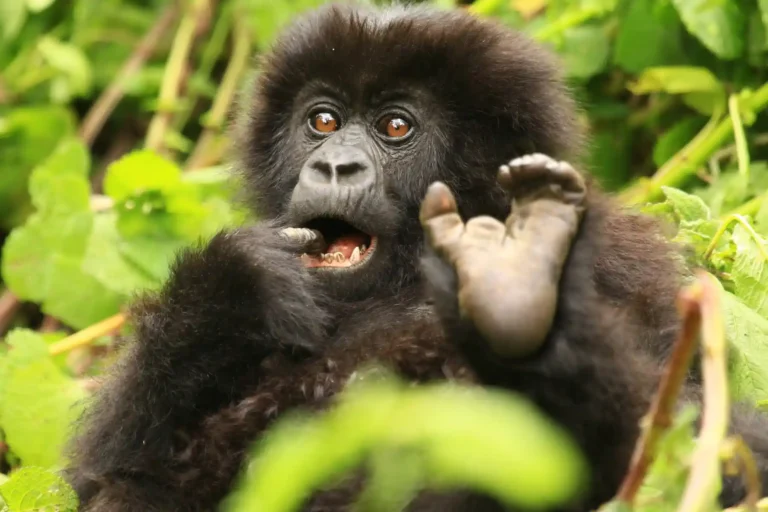
Mountain gorillas were once on the brink of extinction. In the mid-1980s, fewer than 300 remained in the forests of Uganda, Rwanda and Congo. Today, their population has grown to a little over 1000, distinguishing them as one of the few endangered species on the rise. One of the organisations contributing to their protection is Gorilla Doctors, a non-profit organisation based in all three countries and inspired by primatologist Dian Fossey. Its veterinarians provide medical care to gorillas, particularly when they suffer injuries or illnesses that threaten their lives. You can learn more about this work through an evening visit from a field veterinarian at your lodge, either before or after your gorilla trek. During this fireside talk, the veterinarian takes you behind the scenes and explains how the team protects these remarkable animals. It is a fascinating opportunity to understand what goes on behind the scenes of gorilla conservation. You will probably look at your gorilla trekking experience a little differently afterwards, knowing how much work goes into protecting these animals.
Gorilla Habituation Experience
If you have like three nights at Bwindi, we recommend combine gorilla trekking with a gorilla habituation experience. This special activity takes place in the Rushaga sector. Instead of visiting a fully habituated gorilla family, you join researchers and rangers who are working with a family that is still getting used to human presence. Unlike a regular gorilla trek, where you spend one hour with the gorillas, the habituation experience allows you to spend up to four hours with them. You can observe their behaviour, learn how researchers identify individual gorillas, and witness how trust between humans and gorillas is slowly built. The experience feels less like a visit and more like being part of the fieldwork.
What makes it different?
- Up to four hours with the gorillas.
- More focus on research and conservation.
- Opportunities to observe less predictable behaviour.
- A longer and often more physically demanding trek.
This experience is particularly interesting if you want to understand more about gorilla conservation and what happens behind the scenes. Do note that it requires patience, time and a reasonable level of fitness.
Bird watching
Besides mountain gorillas, Bwindi Impenetrable Forest is also one of Africa’s best forest birdwatching destinations. The forest is home to around 350 bird species, including 23 Albertine Rift valley endemics. This makes it particularly interesting for birdwatchers hoping to spot species that are difficult to find elsewhere. Some of the notable species include Chapin’s flycatcher, short-tailed warbler, green tinkerbird, Shelley’s crimsonwing, Rwenzori turaco, handsome francolin and African green broadbill. Read more about birding in Uganda.
Lake Bunyonyi
Lake Bunyonyi is one of Uganda’s most scenic spots, about a one-hour drive from the Buhoma sector of Bwindi and a three-and-a-half-hour drive from the Rushaga sector. It is a good place to slow down after gorilla trekking, explore the area on foot, or spend some time on the water. The lake has 29 islands scattered across calm blue waters, surrounded by green hills. There are several ways to enjoy the area. You can hike to the viewpoint at Arcadia Lodge for a beautiful view over the lake and its islands. You can also explore the lake in a traditional dugout canoe or go swimming. The water is bilharzia-free, making it suitable for swimming. If you want to learn more about local life, you can join a walking tour around the lake.
Frequently Asked Questions
Can you do a gorilla trek twice?
Yes. Some travellers who have three nights in the area deliberately choose to go gorilla trekking twice, sometimes in different sectors of Bwindi. Each gorilla family is different, and the trekking routes through the forest also vary. This means a second trek can offer a different experience. You will need a separate gorilla permit for each trek.
Can I book a gorilla trekking day trip in Uganda?
In principle, yes. You can do a one-day gorilla trekking trip once you are in Uganda. However, there are a few things to consider. First, you need a gorilla trekking permit, and availability at short notice is not guaranteed, especially during the peak tourist season from June to August. The other challenge is the distance. Kampala and Entebbe are at least a 10-hour drive from Bwindi and Mgahinga, where gorilla trekking takes place. If you are travelling from either city, the minimum realistic duration is three days and two nights or 4 days and three nights.
However, if you are already staying near the parks, a one-day trek is possible. From Kisoro Town, you can reach the Rushaga and Nkuringo sectors of Bwindi or Mgahinga Gorilla National Park for a trekking day trip, provided you have a permit for the right location. For Buhoma and Ruhija, it is best to arrange accommodation in Kabale Town or closer to your assigned trekking sector.
Is 2 days enough time to see the gorillas in Uganda?
Yes, depending on where you start your trip. However, a two-day gorilla trekking tour is not realistic if you are travelling by road from Kampala or Entebbe. The drive to Bwindi Impenetrable or Mgahinga Gorilla National Park takes at least 10 hours each way. If you are starting from Kampala or Entebbe, you need at least three days and two nights. You drive to the park on the first day, spend the night near your trekking sector, go gorilla trekking the following morning and return to Kampala or Entebbe on the third day.
A two-day trip is more realistic if you start from Kigali, the capital of Rwanda. Depending on which park or sector you visit, the drive from Kigali takes approximately 4 to 6 hours. You can drive into Uganda on the first day, spend the night near the park, go gorilla trekking the next morning and return to Kigali afterwards.
You might wonder why you would travel from Rwanda to Uganda for gorilla trekking when Rwanda also offers the same activity. The main reason is the price. Uganda’s standard gorilla trekking permit costs US$800 per person for foreign non-residents, compared with US$1,500 in Rwanda. Both countries also have different rates for residents and African citizens, and may offer low-season discounts.
Read more about the differences between gorilla trekking in Uganda and Rwanda.
Is 3 days enough time to see gorillas in Uganda?
Yes. Three days is enough for a gorilla trekking safari from Kampala or Entebbe. However, it is the minimum duration and involves a lot of driving.
The road trip from Kampala or Entebbe to Bwindi Impenetrable or Mgahinga Gorilla National Park takes at least 10 hours each way. You therefore need to spend one night near the park before your trek and another night after it, before driving back.
If you would rather spend less time on the road, you can take a domestic flight to the region. This costs more but saves considerable travel time. Another option is to extend your trip and include Queen Elizabeth National Park or Kibale Forest National Park. You can also start and end your gorilla trekking safari in Kigali, Rwanda. This makes a shorter trip possible, while still allowing you to benefit from Uganda’s lower gorilla permit price.