Categories
- Accommodation
- Accommodation at Kibale Forest
- Active
- Active Tour Lodges
- Best Bwindi Guides
- Best Lodges
- Best Luxury
- Birding Guides
- Budget accommodation at Kibale
- Budget accommodation in Uganda
- Budget Hotels in Entebbe
- Budget Murchison Falls Accommodation
- Bwindi Guides
- Bwindi Lodges
- Bwindi National Park Guides
- Culture
- Culture & Nature
- Entebbe Hotels
- Exclusive Lodges In Bwindi
- Exclusive Lodges In Murchison Falls National Park
- Exclusive Lodges in Queen Elizabeth National Park
- Family
- Family Friendly Lodges
- Family Guides
- Good lodges
- Gorilla Trekking
- Gorilla trekking guides
- great blogs
- Guides
- Health Travel Informations
- High End Accommodation At Kibale
- Jinja Accommodation
- Kampala Hotels
- Kibale
- Kibale Guides
- Lodges in Mgahinga
- Luxury accommodation at Kibale
- Luxury Accommodation in Queen Elizabeth National Park
- Luxury Accommodation Options
- Luxury Hotels In Entebbe
- Luxury Lodges In Bwindi
- Luxury Murchison Falls Accommodation
- Midrange accommodation at Kibale
- Midrange Hotels In Entebbe
- Midrange Lodges In bwindi
- Midrange Murchison Falls Accommodation
- Murchison Falls Guides
- Murchison Falls Lodges
- Murchison Lodges
- Nature and Culture lodges
- News
- News and Blogs
- Popular
- Primate Lodges
- Primates
- Queen Elizabeth Guide
- Queen Elizabeth National Park Accommodation
- Queen Guides
- Related
- Related active
- Related animals
- Related waters
- Semi Luxury Lodges In Bwindi
- Semi-Luxury Entebbe Hotels
- Travel Guide
- Travel Inspirations
- Uganda Honeymoon Lodges
- Uncategorized

Antelopes in Uganda
Uganda is primarily known as a primate country. But there is another group of mammals that is well represented in Uganda with around 30 species, namely the antelopes.
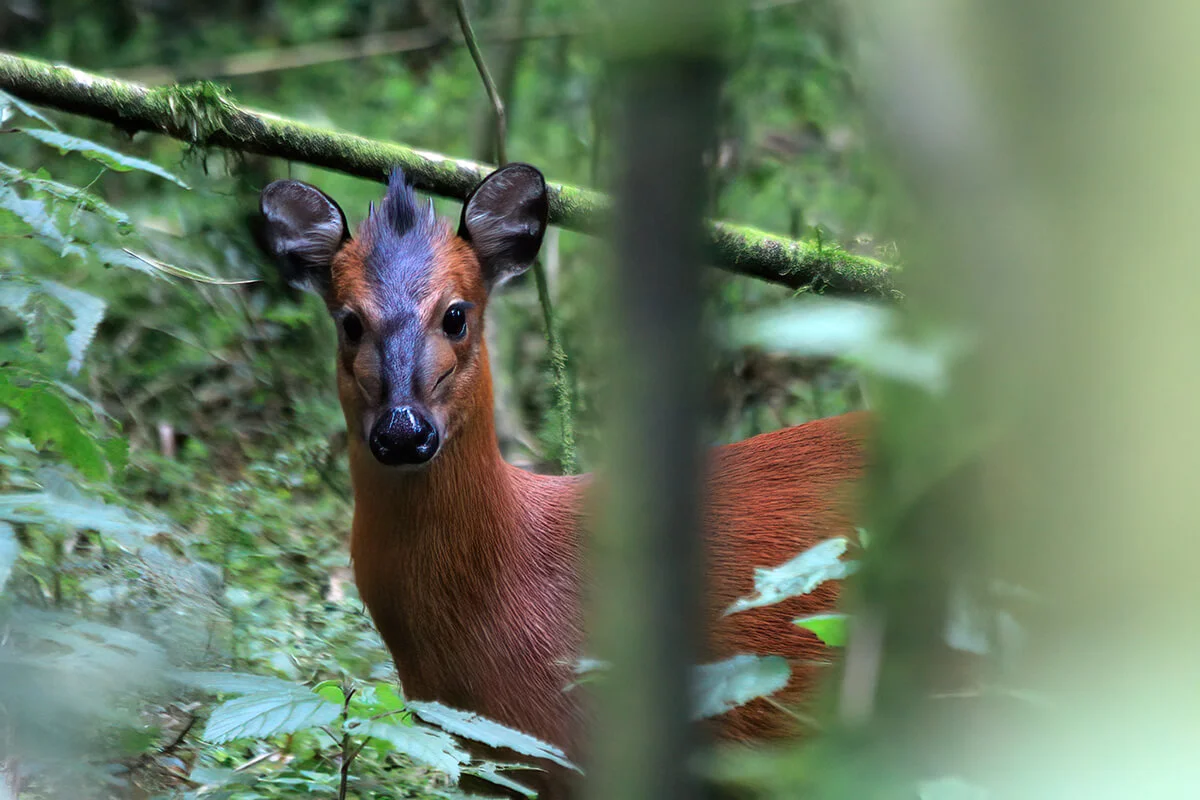
Antelopes belong to the Bovidae family, also called hollow-horned animals.
Their most striking feature is their straight, unbranched horns. Some species have horns in both males and females. In others, only males have horns, or the females’ horns are smaller. Other well-known hollow-horned animals include cows, sheep, and goats.
The smallest antelope in Uganda is the Bates’s pygmy antelope. It lives in the rainforests of western Uganda. It stands just 24–33 cm at the shoulder and weighs up to 5.5 kg.
At the other extreme is the eland, Uganda’s largest antelope. It can reach 178 cm at the shoulder and weigh nearly 1,000 kg. From tiny to giant, Uganda’s antelopes are fascinating to see.
By Ssonko Rashidu
Lelwel hartebeest
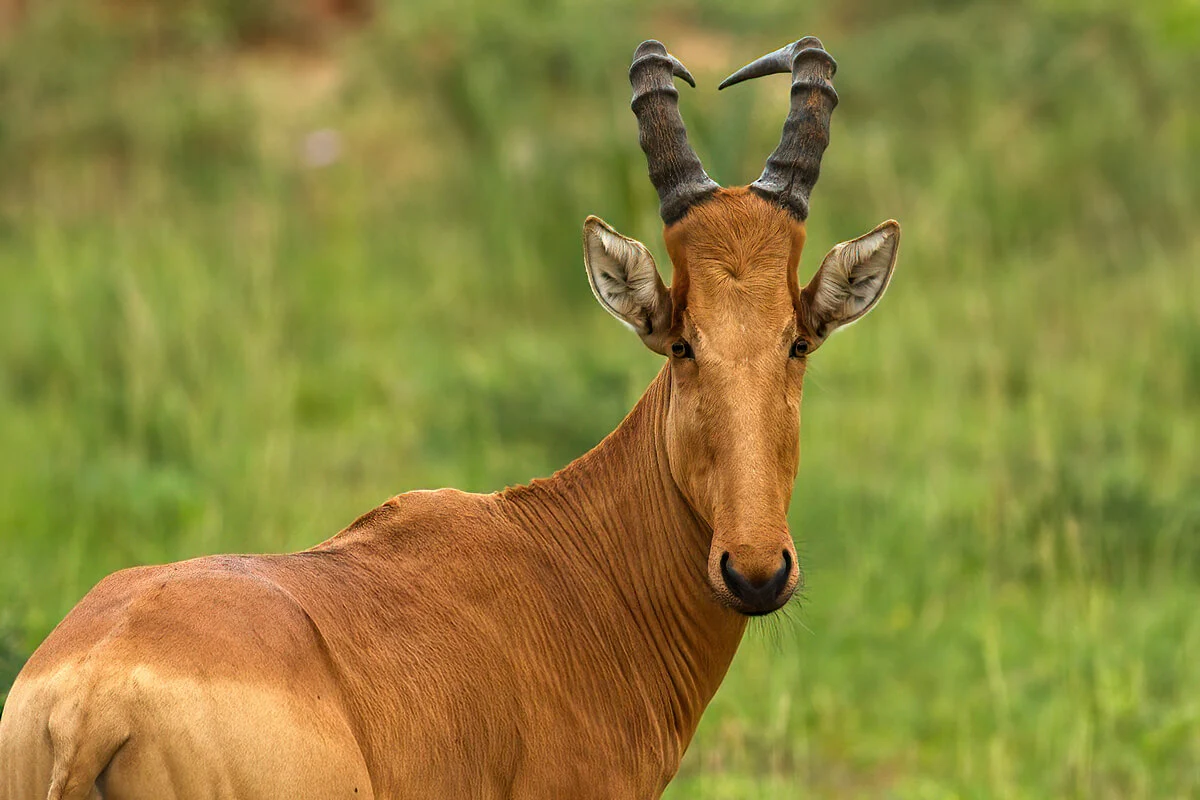
The Lelwel hartebeest, often called Jackson’s hartebeest by wildlife rangers in Uganda, is a large antelope. It has long legs, a relatively short neck, and a narrow, long head.
Its coat is reddish-brown to yellowish-brown, with a lighter belly and rump.
The horns of both males and females form a ringed ‘V’ with tips pointing backward. The species is classified as endangered by the IUCN, though it can still be seen in good numbers in Uganda.
You can spot Lelwel hartebeest in Murchison Falls National Park, Kidepo Valley National Park, and Pian Upe Wildlife Reserve.
Topi
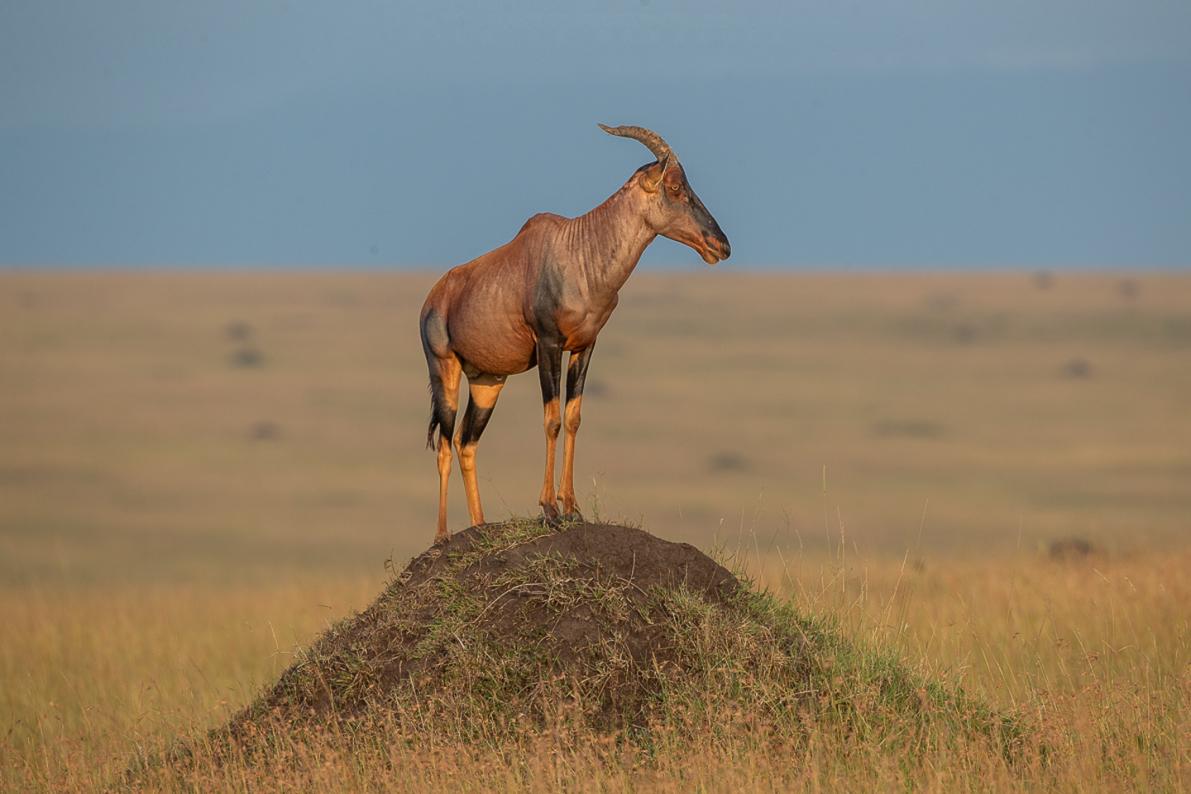
The topi, also known as the Ugandan topi or Ankole topi, is a beautiful antelope. It has a clear hump at the base of its neck. Its coat is glossy reddish-brown, with dark patches on the upper legs and light ochre-colored “socks.” A dark blaze runs from the horns down to the nose.
Both males and females have horns, though they are shorter and rounder than those of the Lelwel hartebeest. Young calves have a soft sandy coat.
Male topi show their strength in a unique way. They stand on raised ground like termite mounds or small hills to watch over their territory. Lelwel hartebeests also do this, but less often.
Topi are mainly found in southern Uganda, especially in Queen Elizabeth National Park and Lake Mburo National Park. The only place where topi and Lelwel hartebeests live together is Pian Upe Wildlife Reserve.
Kob
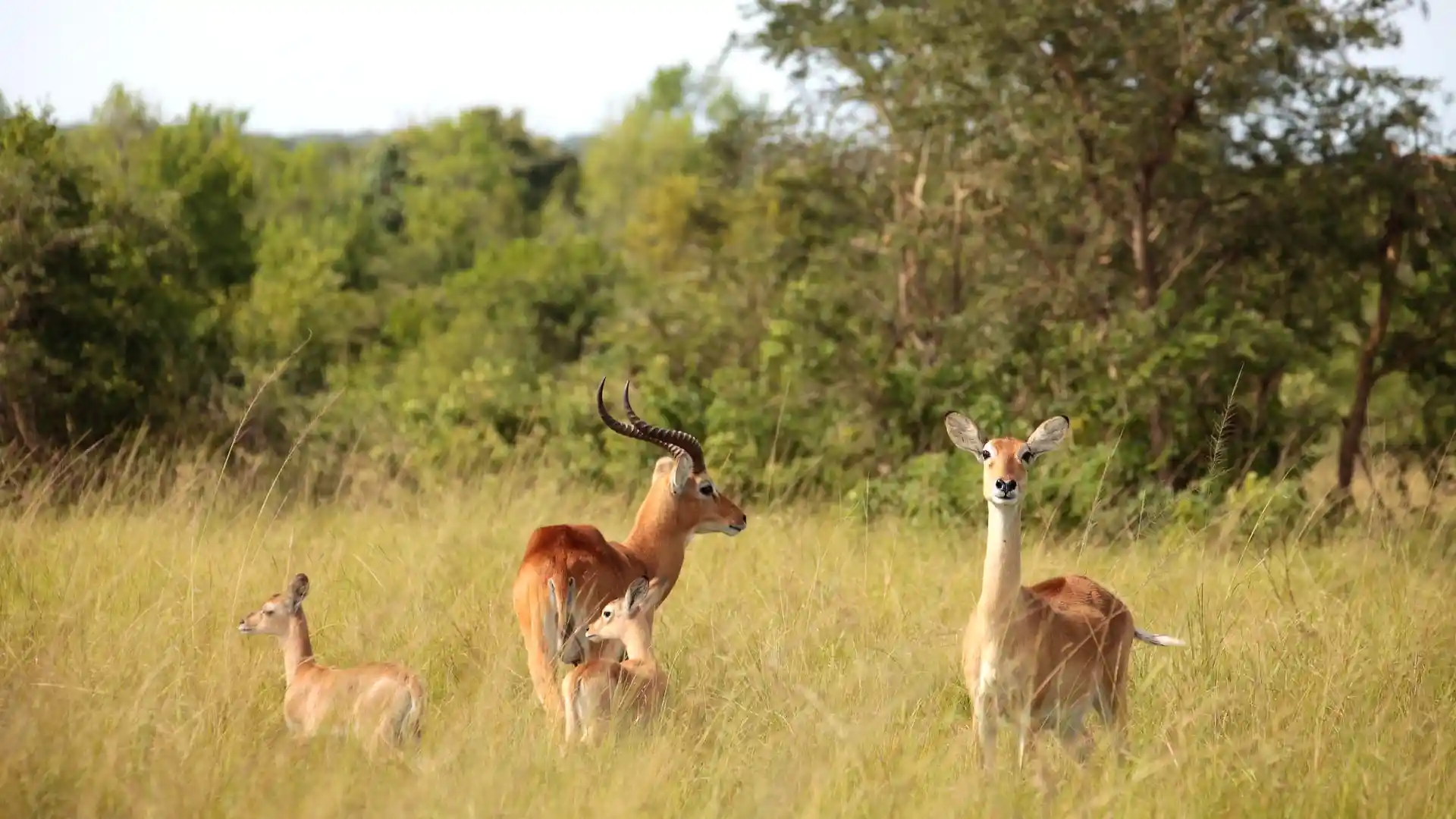
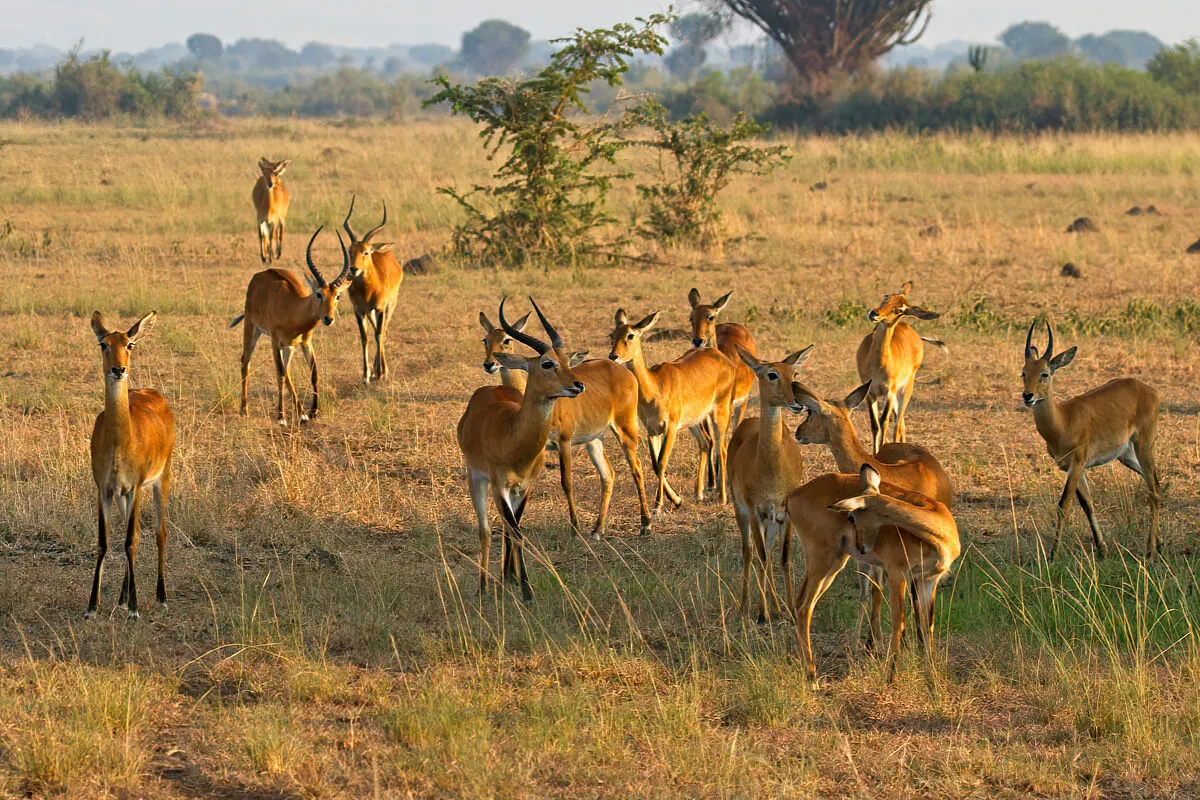
The kob, also known as the Ugandan kob, is a common antelope in northwestern and western Uganda.
It lives in grasslands and floodplains, especially near the Nile River. Large populations can be seen in Murchison Falls National Park and Queen Elizabeth National Park. The species was recently reintroduced to Kidepo Valley National Park after disappearing due to poaching.
The kob is a strong and solid antelope. Males have thick necks and carry beautiful lyre-shaped horns.
Females are smaller, slimmer, and do not have horns.
The coat is rich reddish-brown, with some variation in shade.
The belly and throat are white. The white throat patch is important during the mating season, as males use it to attract females and show dominance.
Herd animal
Kobs live in small herds of about 15 to 40 animals.
During the dry season, these groups can grow much larger. Sometimes, hundreds of females and young move together in search of food.
Adult males stay close to breeding areas. Younger and older males without territory often form bachelor groups. Living in herds has clear advantages. Kobs prefer open areas with short grass.
This helps them spot predators like lions, leopards, and cheetahs early and escape quickly.
Whistling Romeos
The love life of the kob is fascinating. It involves display, competition, and mating.
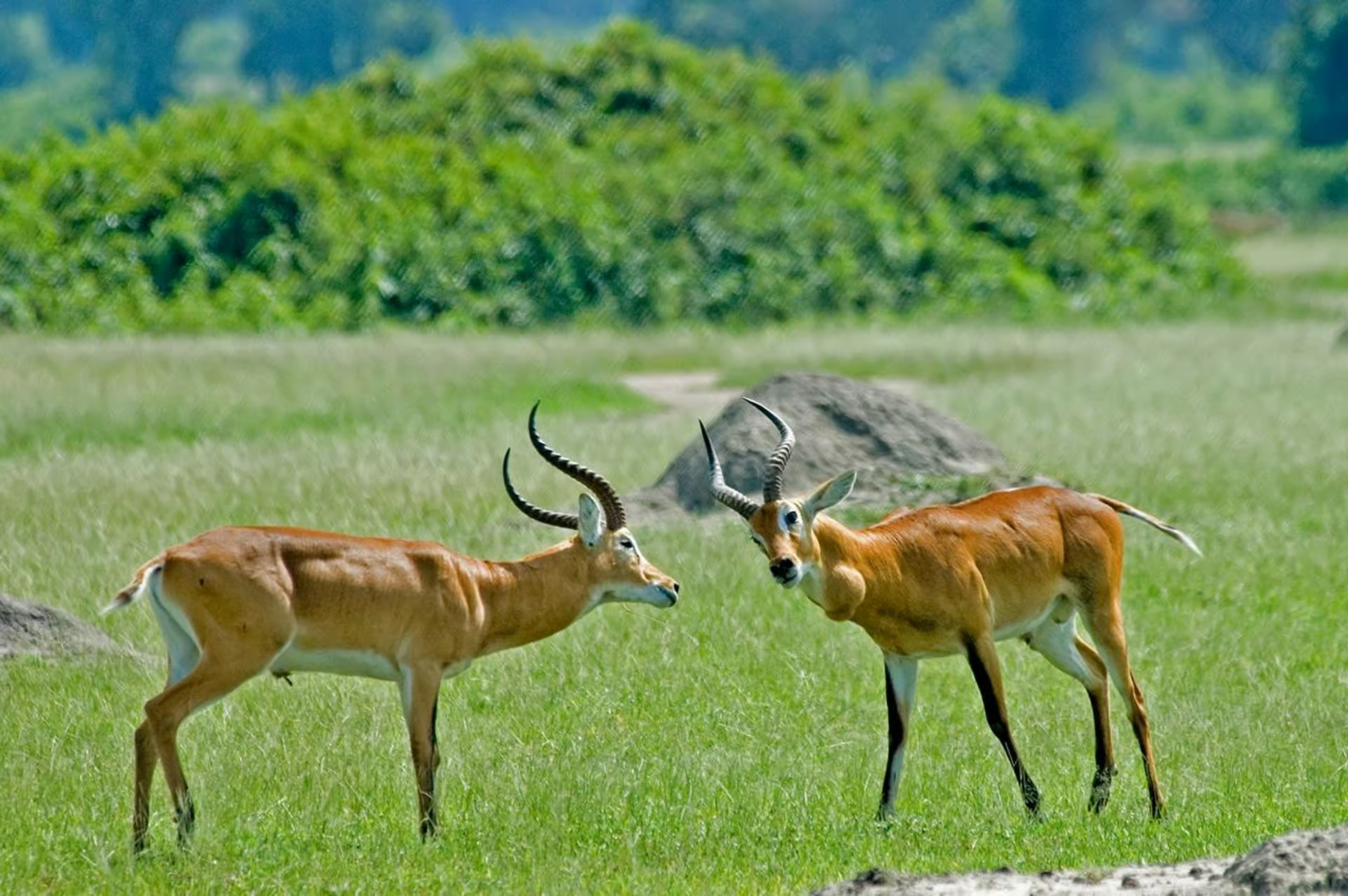
During the breeding season, males gather in special areas called leks, or arenas.
These places have been used for many generations. Each lek can have 20 to 200 males. Every male controls a small territory, usually between 15 and 200 m². These arenas are easy to spot. The ground is bare, with very short grass, and surrounded by taller vegetation.
Dominant males stay in their territory all day. They keep females close and defend their space from rivals. When another male approaches, the resident male shows a proud posture. He displays his white throat patch, shakes his head, and often whistles or growls.
Sometimes, he even turns his head away as a sign of strength. If the rival does not back down, a fight begins. The fight ends when one male gives up and runs away.
Impala
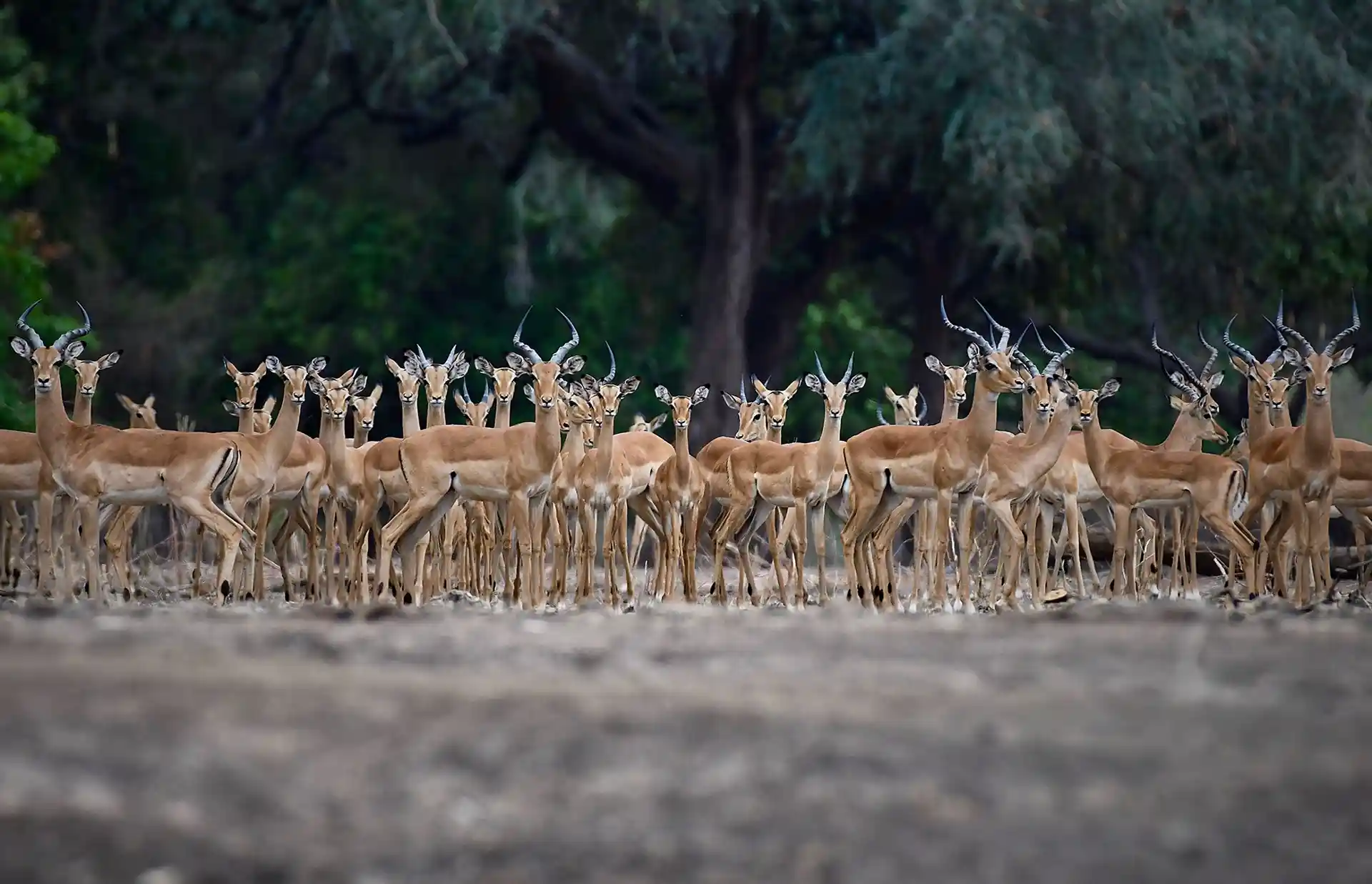
The impala is an elegant antelope that looks similar to the kob.
Although both live in Uganda, they are not found in the same areas. In Uganda, impalas can only be seen in Lake Mburo National Park. The impala is slender and very graceful. Males have long, lyre-shaped horns.
The coat is reddish-brown, with lighter sides and a white belly. A key feature is the black markings. Impalas have black spots on their hind legs, which cover scent glands.
They also have two clear black stripes on their rump. Impalas prefer open woodland with patches of grass. They avoid thick forests and wide-open plains. They also stay close to water and areas with good cover.
They are both grazers and browsers. This helps them survive in different seasons. During the rains, they feed on fresh grass. They also eat fruits and acacia pods.
High jumpers
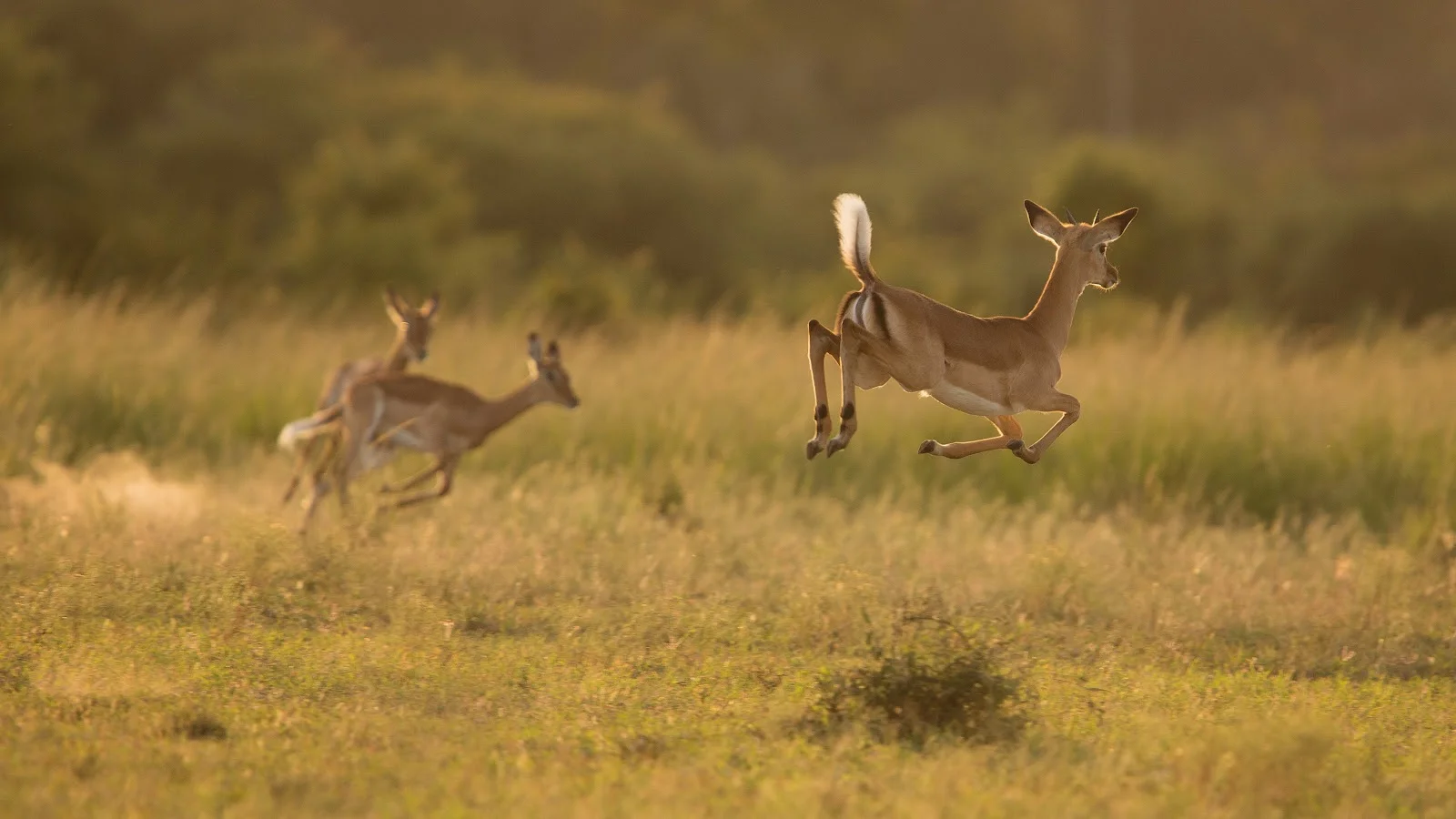
When in danger, impalas react very fast. They run and make powerful leaps. They can jump high and far with great ease. The black spots on their hind legs play an important role. These spots cover scent glands. They may help impalas leave scent trails. This allows the group to find each other again while escaping danger.
Defassa waterbuck

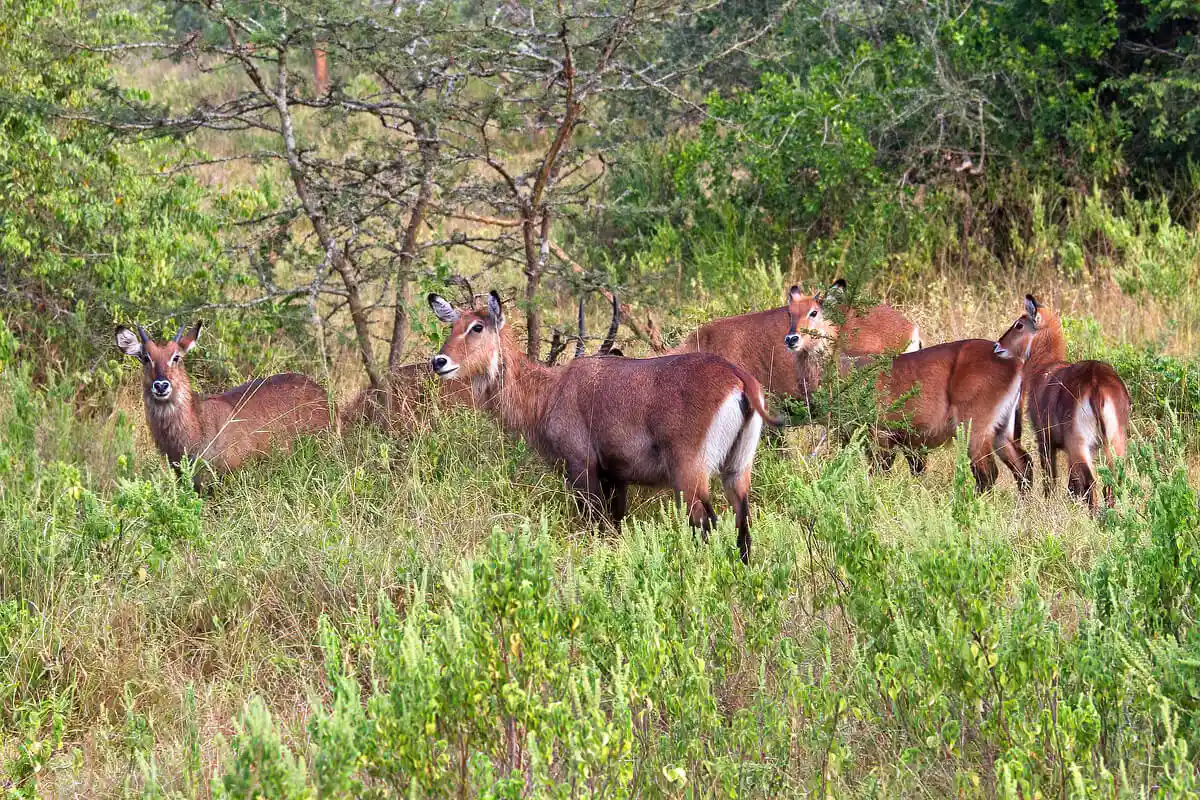
The Defassa waterbuck is one of the most common antelopes in Uganda. It can be seen in many national parks, including Murchison Falls, Queen Elizabeth, Kidepo Valley, and Lake Mburo.
However, it is not found in dense forest parks like Bwindi or Kibale.
This antelope has a thick, coarse coat. The color ranges from grey-brown to reddish-brown. It has a clear white ring around the nose, a white line above the eyes, and a white throat patch. Only males have horns. Their horns are long, slightly curved, and ringed, reaching about 75 cm.
The coat produces an oily substance that helps keep it waterproof. It also gives the animal a strong, noticeable smell. As its name suggests, the waterbuck always stays close to water. It drinks every day. Males prefer open grassland with scattered trees, while females stay more in open woodland.
They feed on grasses, leaves, and plants that other animals often ignore.
Flight behavior
Despite its strong smell, the Defassa waterbuck is often hunted by lions, leopards, and hyenas. When it feels danger, it quickly runs to water.
It can swim well and often moves to deeper areas to stay safe. Its thick coat helps protect it in the water. It does not cool down easily, even after staying in the water for some time.
Sometimes, it hides almost completely. Only its nostrils remain above the surface. Even though it depends on water for safety, the Defassa waterbuck is not an aquatic animal.
Once the danger is gone, it returns to land. This is different from animals like the sitatunga, which live in swampy areas for most of their lives.
Oribi
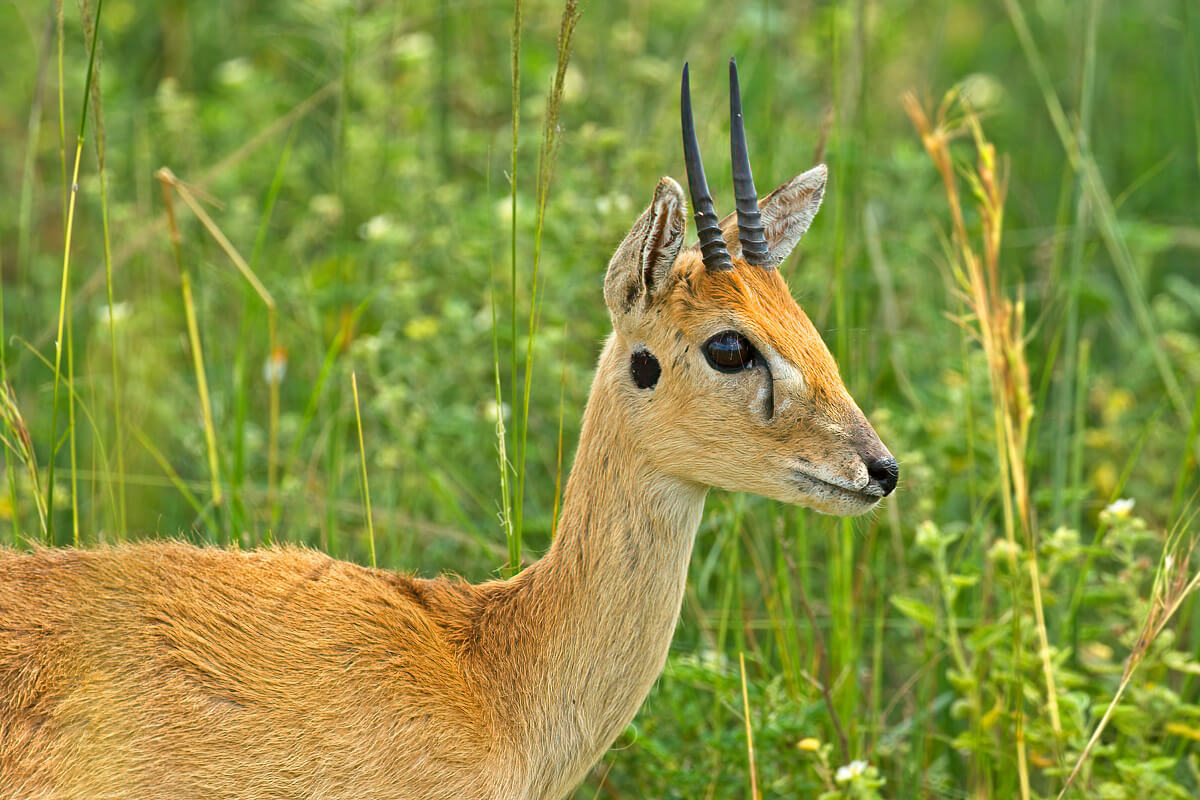
The oribi is one of the smaller antelopes in Uganda.
It belongs to the group of dwarf antelopes and is widely found across the country.
It prefers open grasslands and plains. You can often see it in Murchison Falls, Kidepo Valley, Queen Elizabeth, and Lake Mburo National Parks.
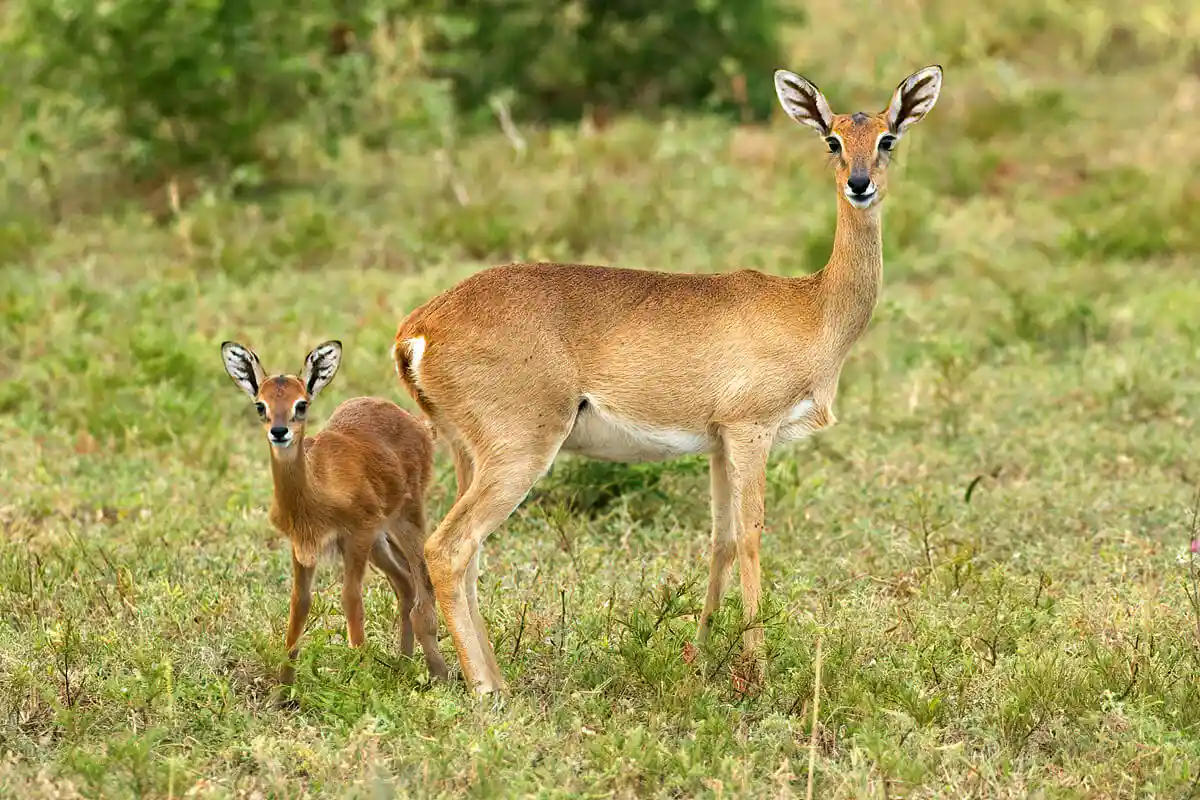
The oribi has a light yellowish-brown coat and a white underside. Its throat, inner ears, and mouth are also white. A thin white line sits above the eyes. One of its most striking features is the black patches below the ears. These are scent glands used to mark territory.
The oribi has several scent glands on its body, including on the legs.
It also has a short tail with a clear black tip. Only males have horns. These horns are straight at first but curve slightly forward as the animal grows older.
Flat-bottomed animal
The oribi lives in open savannas, floodplains, and grasslands.
It prefers areas with short grass for feeding and taller grass for resting. It does especially well where larger animals keep the grass low. Oribis also like areas affected by seasonal fires or controlled burns.
These help new, fresh grass to grow. Unlike many other antelopes, oribis do not depend on water.
They get enough moisture from the plants they eat. They avoid areas with only tall grass. In such places, it is harder to see danger. Since many predators hunt them, good visibility is important for survival.
Territory
Oribis live in small family groups, usually two or three animals.
Males mark their territory using scent glands. Families also have shared spots where they relieve themselves, which helps show the boundaries.
A pair of oribis often stays in the same territory for many years. This helps them know their land and stay safe from rivals and predators.
Eland antelope
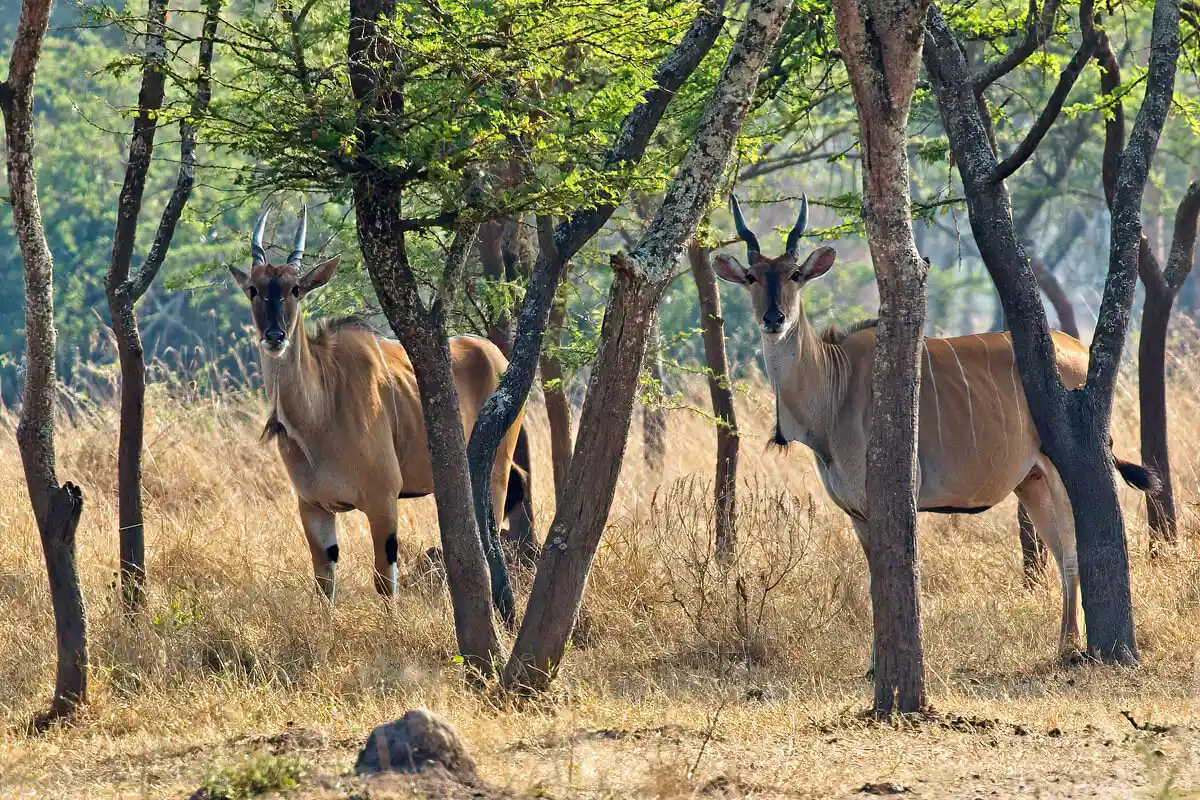
The eland is Uganda’s largest antelope.
A bigger relative, the giant eland, may appear in the far northwest, occasionally crossing from South Sudan, but this area is too unstable to visit safely.
You can see elands more reliably in Lake Mburo NP, Kidepo Valley NP, and Pian Upe WR.
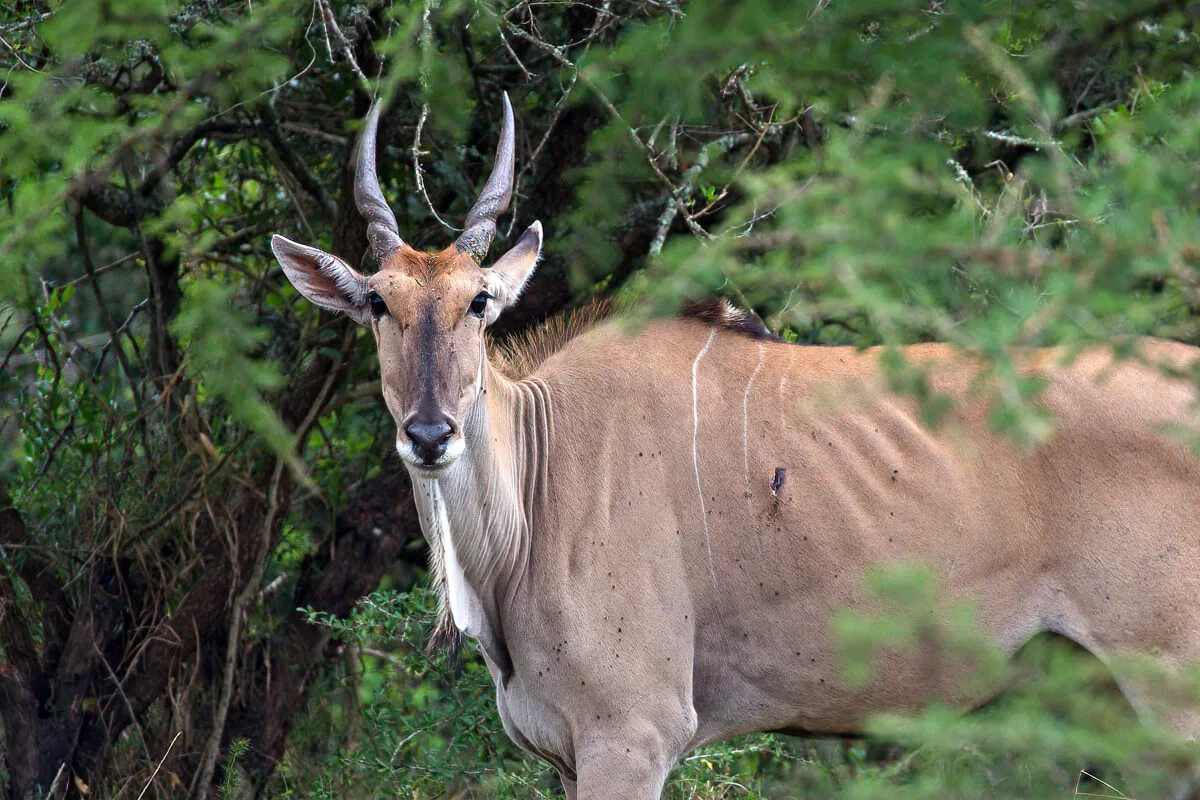
Elands are very large with grey to grey-brown coats. As bulls get older, their coats turn a lighter grey. Bulls have a dark “mullet” on their foreheads that grows with age.
Both males and females have spiral horns, but the bulls’ horns are bigger and thicker. Their bodies are marked with thin vertical stripes, ranging from white to light grey, which stand out against their coats.
Diet and Habitat
Eland antelopes live in many habitats, from open grasslands to lightly wooded areas.
They are not dependent on water but will drink whenever it is available. Elands are mainly grazers, but they are also browsers, making them true omnivores.
Their diet is diverse, including grasses, herbs, leaves, and fruits. They often use their strong horns to break branches and reach fresh green leaves.
Status and Display
Bull elands make a loud clicking sound when they walk.
This noise can carry for hundreds of meters. Scientists have found that it comes from a tendon rolling over a leg bone. The sound reflects the bull’s size and strength.
By clicking, a bull can show his fitness and claim breeding rights without fighting.
Other signs of dominance include the size of his dewlap, which shows his age, and the dark color of his coat, which signals his level of aggression.
Bushbuck
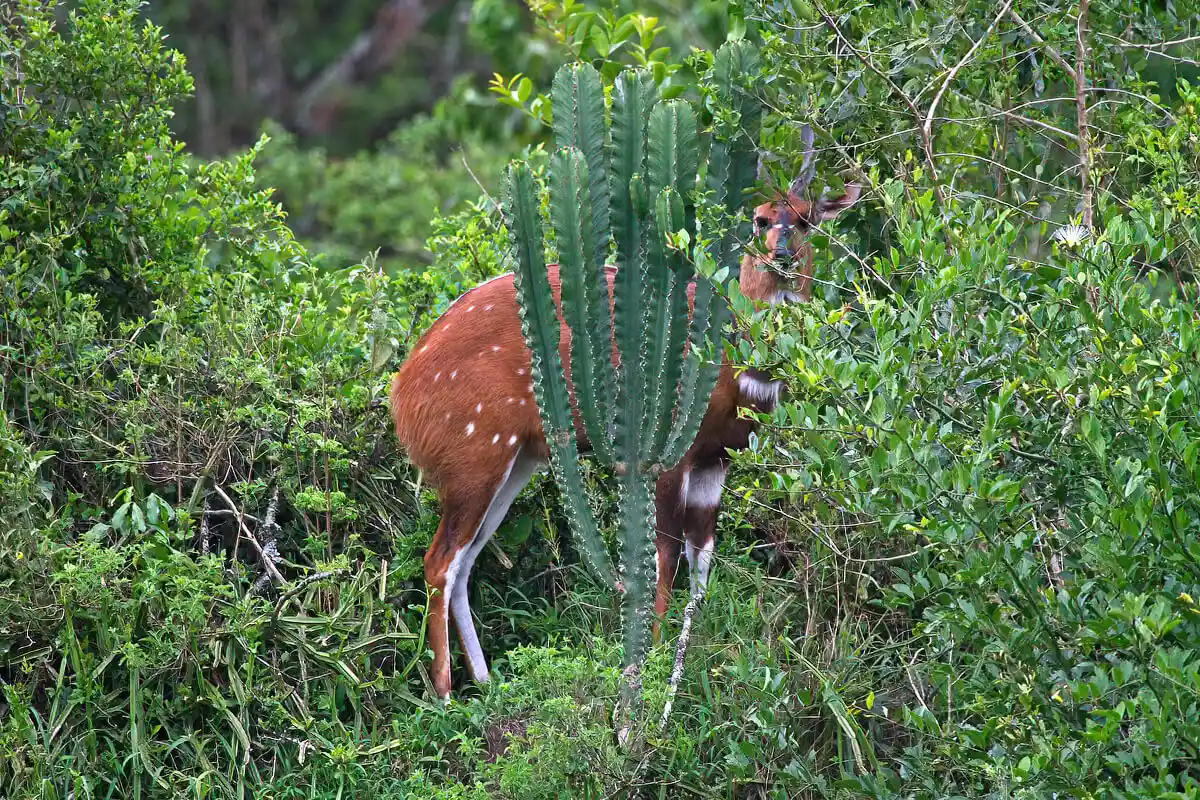
The bushbuck is a small, shy antelope found in Murchison Falls National Park, Queen Elizabeth National Park, Lake Mburo National Park, and Kidepo Valley National Park.
It is the smallest of the screw-horned antelopes. Uganda is home to three bushbuck subspecies, which differ in color, stripe and spot patterns, body size, and horn shape. Scientists still debate how many bushbuck subspecies exist across Africa, with estimates ranging from 8 to 40.
Male bushbucks are reddish-brown to dark reddish-brown, often with white stripes or spots.
Females and young are brighter red but darken with age. Both sexes have white markings on the face, throat, underside, ears, and above the hooves. Only males have twisted horns, averaging 26 cm in length.
When threatened, a male can raise a dorsal crest to appear larger and more intimidating.
Water dependent
Like the Defassa waterbuck, bushbucks need water to survive.
They always live close to rivers, streams, or wetlands. During severe droughts, they can struggle and may even die of thirst. Bushbucks are browsers with a varied diet.
They eat herbs, leaves, flowers, berries, mushrooms, and young grasses, taking advantage of whatever fresh vegetation is available.
Hidden way of life
Bushbucks are secretive and shy.
Even when they are watching you, their reddish-brown coats with white stripes and spots make them hard to spot. They live in areas with dense vegetation, where they can hide most of the day.
Bushbucks usually come out to feed in sunny clearings, but at the first sign of danger, they disappear back into cover. The best chance to see them is during morning or evening game drives.
Lake Mburo National Park is one of the top places to spot these elusive antelopes.
Dangerous fighters
When threatened, a bushbuck raises its dorsal crest and emits a loud bark. Despite its size, it is fearless and highly aggressive. It will defend itself and its family using sharp horns and strong hooves.
In some cases, a bushbuck has even killed a predator. Bucks often position themselves between danger and their group, acting as a protector.
Like African buffalo, bushbucks can ambush intruders with their forward-pointing horns, making them surprisingly formidable in the wild.
Bohor reedbuck
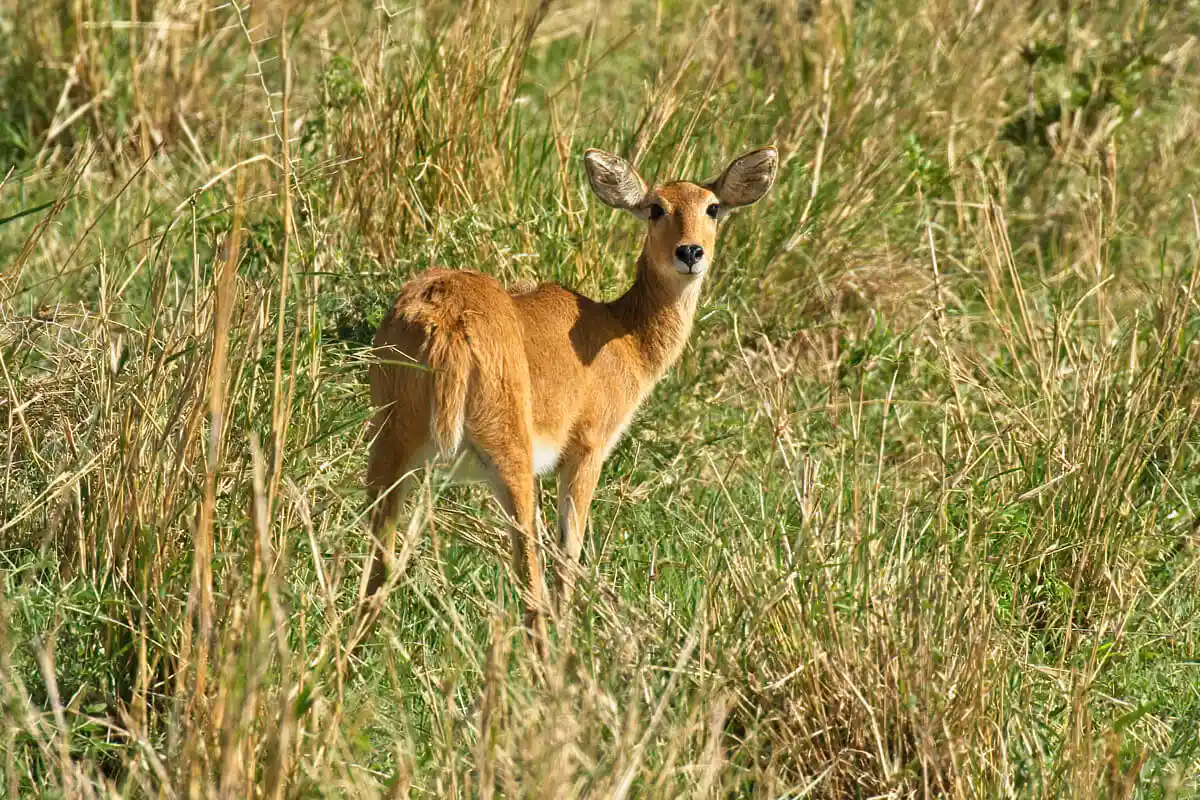
The Bohor reedbuck is a medium-sized antelope with a shoulder height of about 75 cm.
Its forward-curved horns are found only on males. Most of Uganda’s national parks and reserves are home to this antelope in good numbers.
In the far northwest, a subspecies called the Sudanese Bohor reedbuck has longer, thinner horns.
The mountain reedbuck, greyer in color, is rare and lives only on mountain slopes in northeastern Uganda, including Kidepo Valley National Park.
The Bohor reedbuck’s coat is sandy to reddish-brown with two dark stripes on the forelegs.
Like the oribi, it has two black spots under the ears. These scent glands help does signal when they are in estrus. By moving their ears, they spread the scent to attract males.
Water dependent
Bohor reedbucks live mainly on floodplains, where water is always nearby.
They need tall grass for shelter and resting spots. These antelopes are primarily grazers, feeding on grass.
While they are active throughout the day, they mainly graze at night, sometimes traveling up to eight kilometers from their home range.
During the dry season, when grass quality drops, they also feed during the day. In the hottest hours, they rest in the shade of tall grass to stay cool.
Duikers
Duikers are small, shy antelopes belonging to the subfamily Cephalophinae.
There are at least eighteen species, eight of which live in Uganda. Their name comes from Afrikaans, meaning “diver,” because they dive into dense vegetation when threatened.
Duikers are found in most rainforests and some savannas, though most species stick to rainforest habitats. A single forest patch may host several duiker species.
During your trip with Choose Uganda Safaris, you are most likely to spot the common duiker, the blue duiker, or the black-fronted duiker.
The common duiker is usually yellowish-brown or grey-brown and very quick, vanishing into cover at the slightest disturbance. Males are slightly smaller than females and have small, pointed horns.
Occasionally, females have tiny horns. Both sexes have a black tuft on the head, a dark stripe from forehead to nose, and prominent scent glands under the eyes.
Omnivore
The common duiker adapts well to many habitats, from forests to open grasslands with scattered cover. Its legs are longer than those of forest duikers, helping it move quickly across open areas.
However, it avoids plains with only short grass because predators are everywhere.
Lions, leopards, caracals, servals, hyenas, jackals, baboons, pythons, and large eagles like the martial and crowned eagle all hunt it. Humans also hunt duikers for bushmeat and personal use.
Despite being mostly herbivorous, common duikers eat animal food too. They hunt small birds, reptiles, and rodents to supplement their diet. This flexible eating habit helps them survive in diverse environments.
Dikdiks
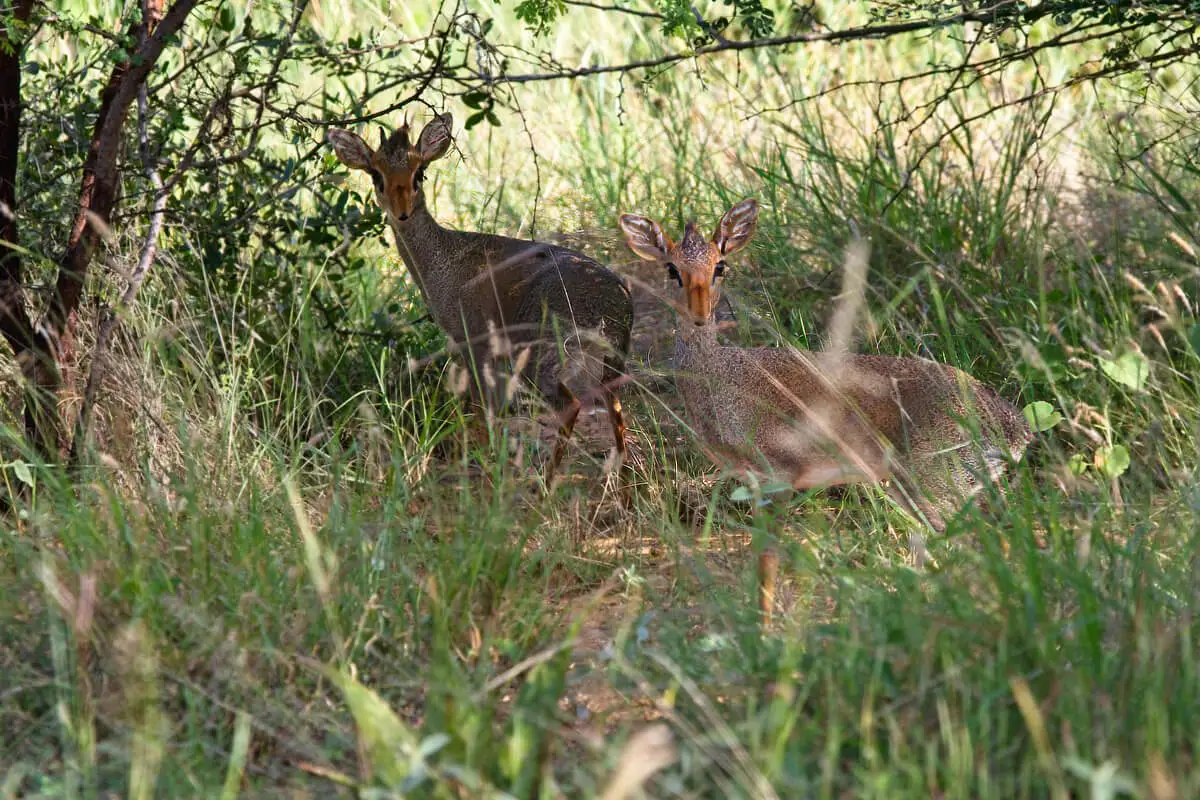
Dik-diks are tiny antelopes that live in dry, warm regions.
They stand 30–40 cm tall and weigh only 3–6 kg.
Their most striking feature is a long nose, which helps keep their body cool. Blood flows through the moist membranes of the nose, lowering body temperature.
In some species, the nose even forms a tapir-like trunk.
Uganda is home to two dik-dik species: Kirk’s dik-dik and Günther’s dik-dik. Kirk’s dik-dik lives near the Kenya border, from Mount Elgon to Pian Upe Wildlife Reserve.
Günther’s dik-dik lives in northeastern Uganda, including Mount Moroto and Kidepo Valley National Park.
Look carefully during game drives; these tiny antelopes hide easily in dense undergrowth. The easiest way to tell them apart is the nose. Günther’s dik-dik has a trunk-like nose, giving it a unique and distinctive look.
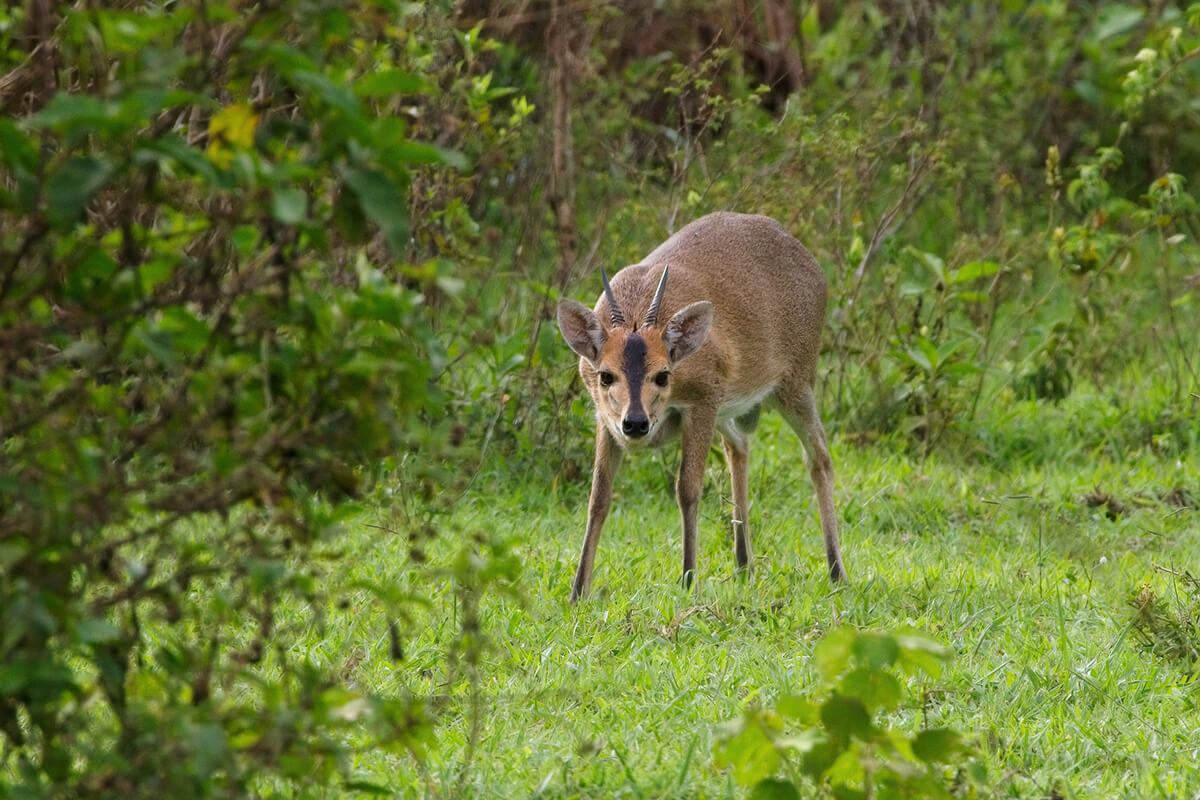
Pointed head shape
Dik-diks live in dry, often hot areas. They hide in shrubs and bushes.
They sometimes venture onto the savannah but avoid tall grass because it blocks their view.
They are grazers that eat leaves, shoots, fruit, and berries. Occasionally, they also eat fresh grass.
Acacia leaves are a favorite. Their pointed head helps them reach leaves and fruit easily, even among sharp thorns. Dik-diks do not need to drink water.
They get all the moisture they need from their food.
Beloved snack
Dik-diks, like duikers, are a favorite prey for many predators.
Lions, leopards, hyenas, jackals, snakes, large eagles, and even Nile monitors may hunt them. Humans also hunt dik-diks for bushmeat. These tiny antelopes have excellent eyesight and are very fast.
When threatened, females make a sharp, repeated “dik” sound, this is where their name comes from.
They can also whistle loudly to warn nearby dik-diks of danger. Their speed, alertness, and warning calls help them survive in a world full of predators.
Sitatunga
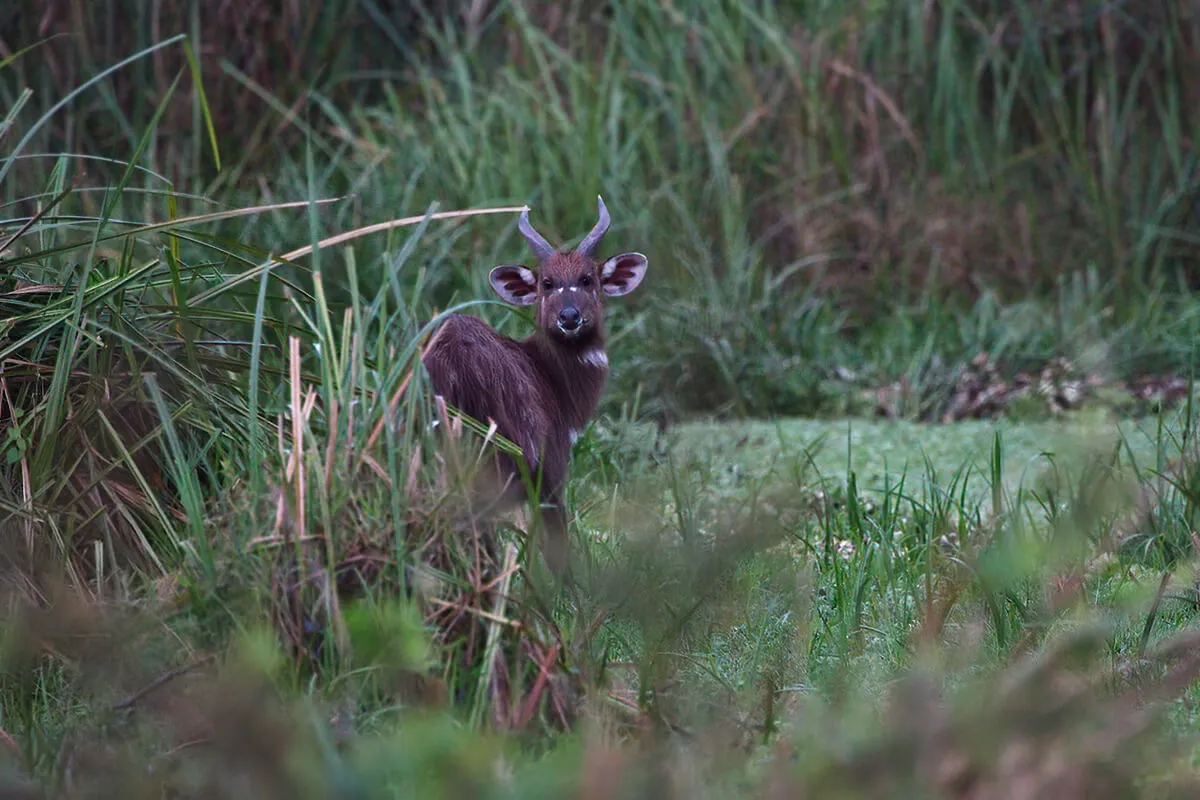
Sitatungas are very shy antelopes that live in Uganda’s wetlands. Two subspecies occur here.
The endemic Ssese sitatunga is found only on the Ssese Islands. The East African sitatunga lives in most major wetlands, including papyrus swamps along Lake Victoria, the Nile, and the Great Lakes.
Sitatungas are perfectly adapted to watery habitats.
They have long, cloven hooves that help them walk on boggy ground.
Their shaggy coat is grey-brown to reddish-brown with white stripes and spots. Like Defassa waterbucks, they secrete an oily substance that makes their coat waterproof. Only males have horns.
All set
Sitatungas often stay in the same spot in a floating papyrus swamp for several days.
On slightly drier ground, they bend and break papyrus stalks to make a bed.
They rest here during the hottest part of the day. They leave the bed only to forage on the mainland or nearby reed beds in the evening, at night, and early in the morning.
Probability of observation
Spotting a sitatunga during a game drive is very rare, it’s mostly a matter of luck.
They live in wetlands in Lake Mburo National Park, Queen Elizabeth National Park, and wildlife reserves like Mabamba Swamp and Katonga Wildlife Reserve.
Your best chance to see one is on a very early morning walk in Katonga Wildlife Reserve.
Sitatungas are elusive and can vanish in an instant.
Bright's gazelle
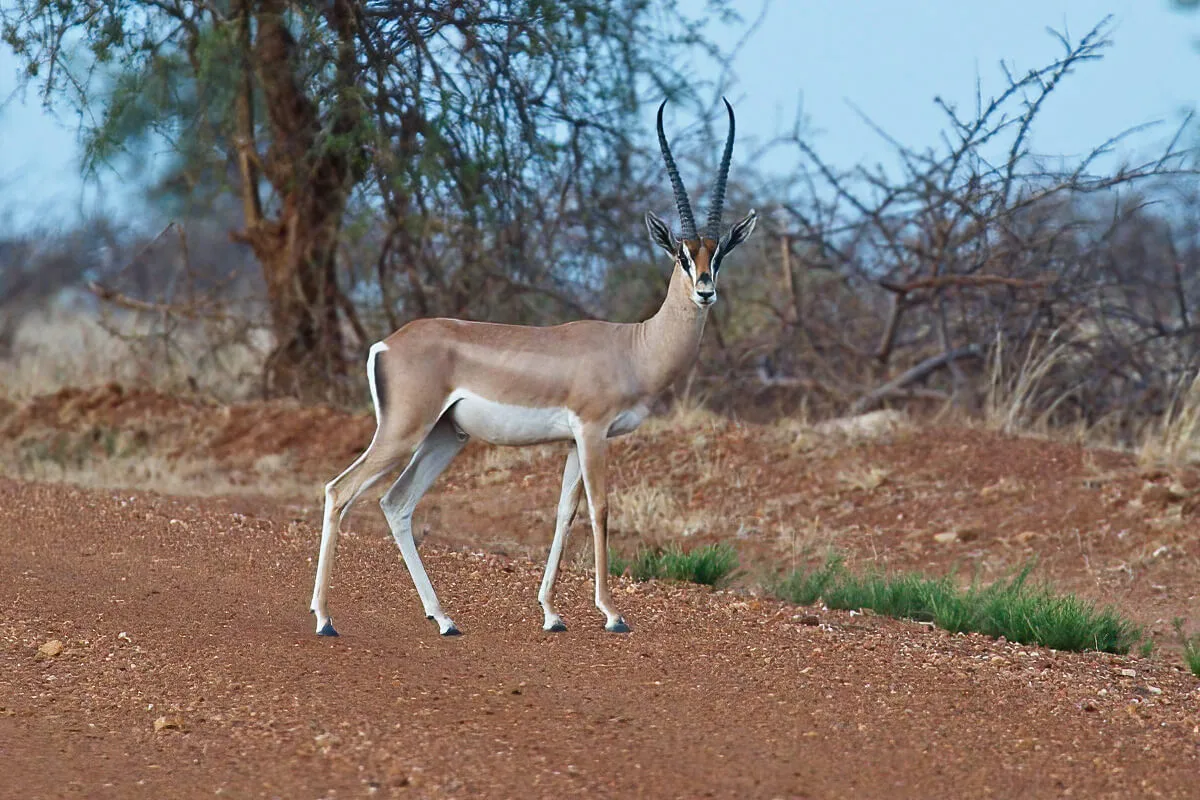
Bright’s gazelle is a slender and graceful antelope.
It lives in dry grasslands, savannas, and semi-desert areas. Like other gazelles, it can go for long periods without water. Uganda hosts only one gazelle species: Bright’s gazelle, a subspecies of Grant’s gazelle.
In Uganda, it is found only in Bogora Wildlife Reserve and Matheniko Wildlife Reserve in the northeast.
Both males and females have black, ribbed, slightly curved horns that can reach 50–80 cm in length.
Their coat is brown with a white belly. A black spot sits above the nose, and white stripes run above and below the eyes, with the upper stripe extending to the nose.
A dark band along the flanks is common, though some individuals have a faint or missing band. Bright’s gazelles move in herds, blending beauty and alertness in Uganda’s dry landscapes.
Cooling system
Bright’s gazelles live in dry grasslands with scattered trees and shrubs. They avoid tall grass because predators often hide there. They can stay in the sun even during the hottest hours, while other animals seek shade. Like dik-diks, they use their long, moist noses to cool their blood and regulate body temperature.
Worth the effort
On our Uganda tours, you usually do not venture far into northeastern Uganda beyond Kidepo Valley National Park. That makes a tailor-made trip even more exciting.
You can start in Mabira Forest Reserve to see the endemic Uganda mangabey, then continue to Jinja to visit the Nile’s source. Next, hike in Mount Elgon National Park and enjoy the spectacular Sipi Falls, especially after the rainy season.
From there, explore Pian Upe Wildlife Reserve, where native wildlife is returning, on one visit, five cheetahs were spotted in a single day! You could also hike Mount Kadam with a guide to see Brazza’s monkeys.
Continue to Bogora and Matheniko Wildlife Reserves, dry regions home to Bright’s gazelle, ostriches, and occasionally the elusive lesser kudu.
Finally, visit Mount Moroto for Hemprich’s tok, return to Kidepo Valley, and on the way back stop at Murchison Falls National Park, Ziwa Rhino and Wildlife Ranch, and Mabamba Swamp to spot shoebill storks before flying home from Entebbe. Inquire about custom possibilities!
Roan antelope (Horse goat -antelope)
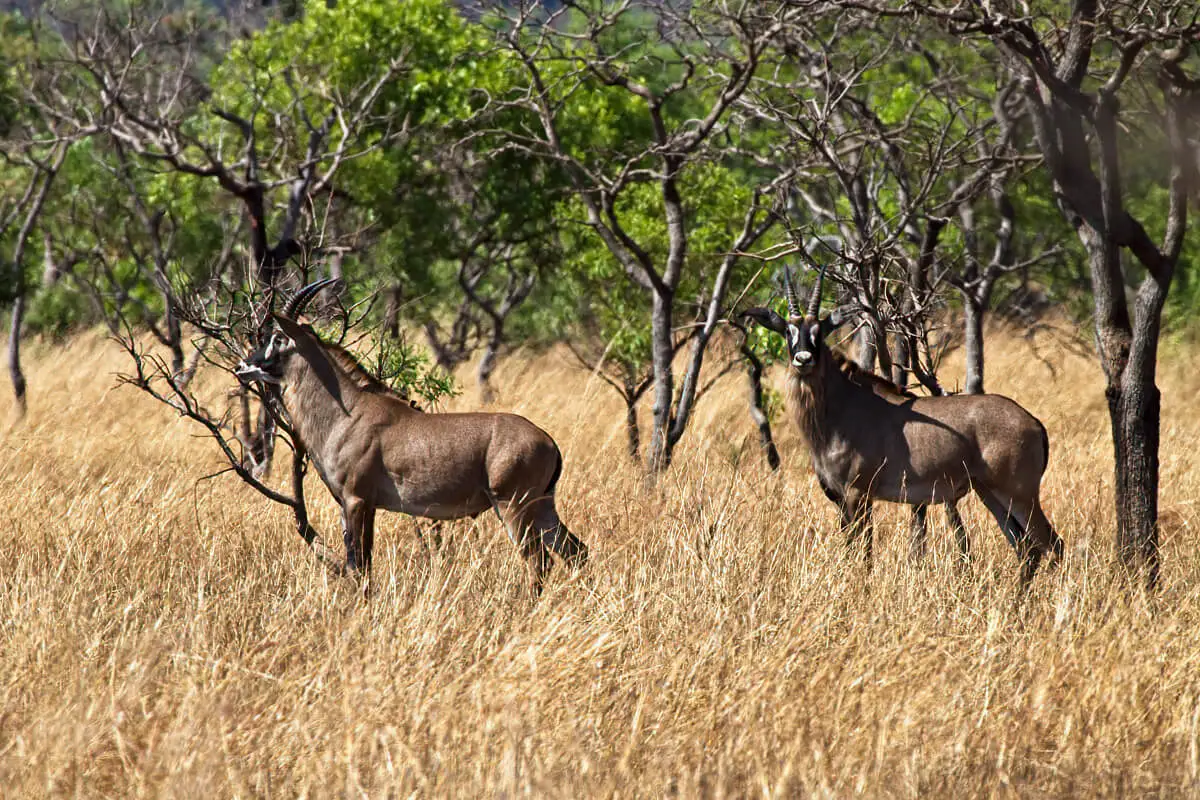
Roan antelopes are large, standing about 150 cm at the shoulder. In Uganda, the only place to see them is Pian Upe Wildlife Reserve. They are shy and often stay hidden in tall grass.
Their coat ranges from sandy brown to gray-brown. The face is striking, with a unique mask of black and white markings. They have large ears with tufts of hair at the tips.
A stiff, upright mane runs along the top of the neck to the withers. Their backs slope downward, with the shoulders higher than the hindquarters. Both males and females have ridged horns.
The females’ horns are shorter and thinner. Roan antelopes are strong and graceful, moving swiftly through the savannah while keeping a watchful eye on their surroundings.
Sensitive animals
Roan antelopes prefer open savannahs with medium to tall grass and scattered trees. They avoid short grass, dense undergrowth, and jungles.
These antelopes are very sensitive to disturbances and changes in their habitat.
They do not cope well when other large grazers move into their area. In such cases, they usually leave to find a quieter spot. Roan antelopes depend on water and have a selective diet.
They feed mainly on leaves and herbs, usually in the morning and evening.
Where to find it?
Roan antelopes in Uganda are found only in Pian Upe Wildlife Reserve.
There are hints of another subspecies in the far south, but your best chance to see them is in Pian Upe. On all our visits, we have always spotted these beautiful animals. Despite their large size, they blend easily into their surroundings. Wildlife in Pian Upe is generally shyer than in other parts of Uganda.
This is because commercial hunting is allowed at certain times of the year. However, this should not discourage you. Local gamekeepers are very helpful and often provide tips on where to find animals.
Want to read more in preparation for your trip to Uganda? We regularly write blogs to help you on your way.
Contact
Follow us on
Safaris BY Type
Packages
About Us
We founded Choose Uganda Safaris with a dream in hand: to organize the most beautiful trips for people who want to discover Uganda. Since then, we have built a passionate local team with one goal: to make your Uganda trip an unforgettable experience.
1
Chat