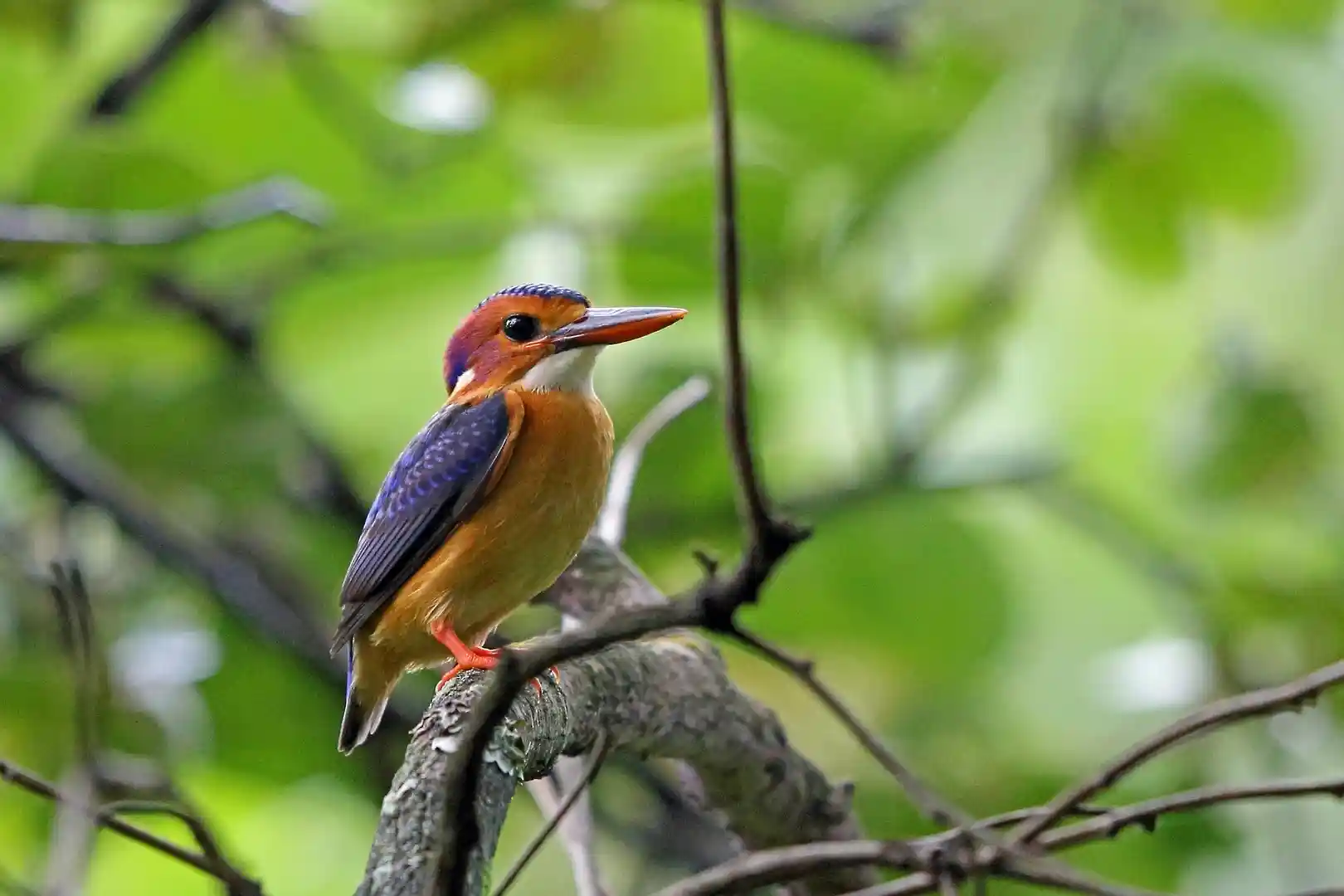
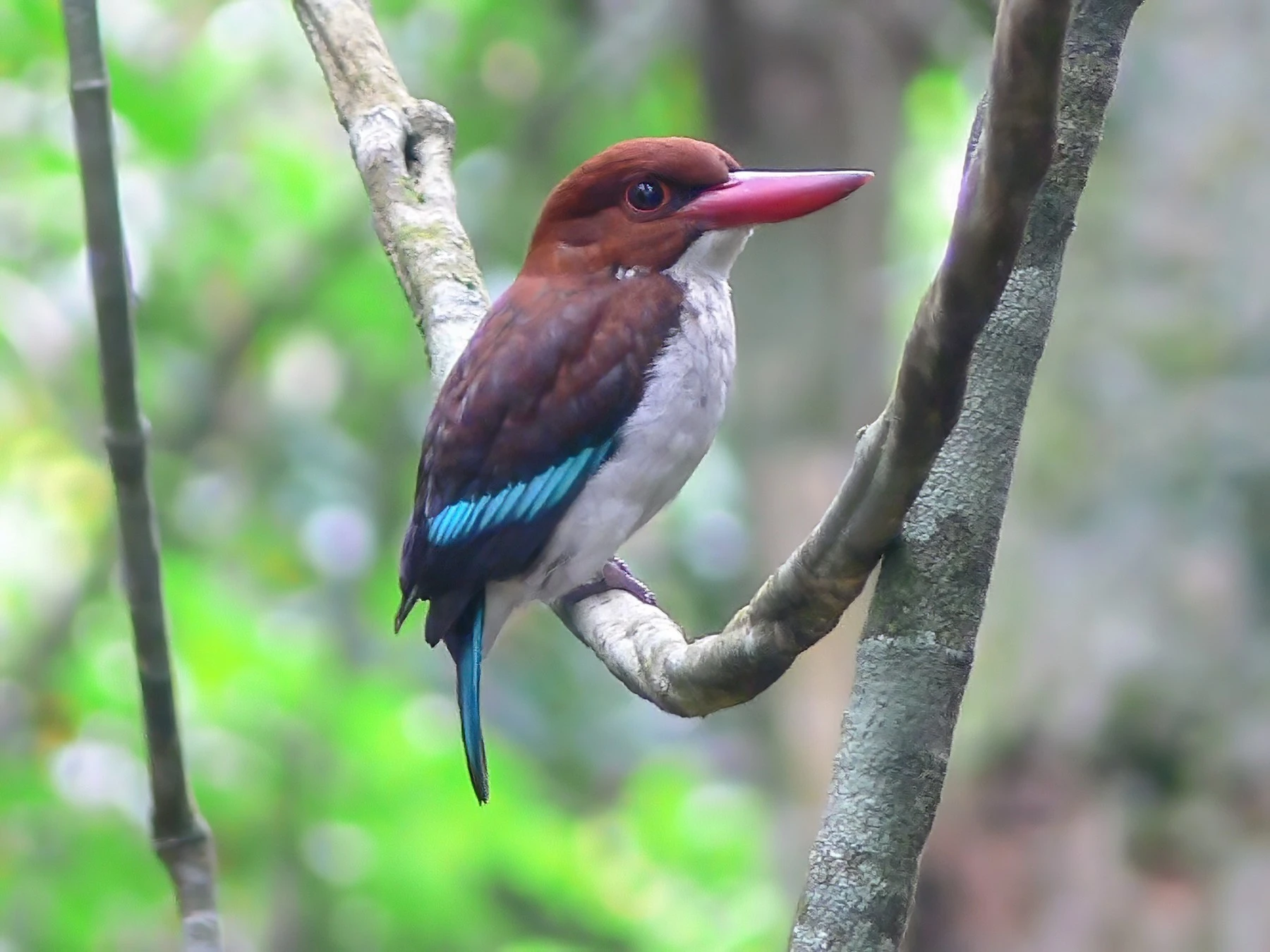
Budongo Forest is a large (825 km2/319 sq mi) tract of intact, virgin tropical forest on the southern edge of the Murchison Falls National Park. In fact, it is the largest natural forest area in all of east Africa. It is known for the massive mahogany trees that grow there, but also for its population of Chimpanzees and phenomenal birdwatching. Budongo Forest Reserve has a checklist of more than 360 birds, including 60 West and Central African species that have a very limited distribution in East Africa. It is also Uganda’s second most important site (after Semuliki National Park) for Guinea-Congo Forest specials. Puvel’s illadopsis, which occurs nowhere else in East Africa, is highly vocal and easily seen on forest paths around the chimp trekking site at Kaniyo Pabidi. Dedicated birders should head to the ‘Royal Mile’. This is probably the best place in East Africa to look for the likes of African dwarf kingfisher, chocolate-backed kingfisher, white-thighed hornbill, Ituri batis and yellow-footed flycatcher.
While birding in Budongo Forest is excellent year-round, and the best birding is to be had from February to April and again from June to September when the trees are fruiting abundantly and birds are in their breeding plumage. Heavy rains in April and May and again in September and October may hamper your activities with slippery trails.
Key Birding Sites in Budongo Forest
Budongo Forest is divided into three main ecotourism sectors, each offering distinctive habitats and rewarding birding experiences for visitors.
1. The Royal Mile
To speak of birding in Budongo Forest is to speak of the legendary Royal Mile.
Located in the Busingiro sector, this premier forest birding road lies beneath a dense yet airy forest canopy and is regarded as one of Africa’s most celebrated birding destinations, often compared—on a global scale—to Peru’s famous Manu Road.
Originally maintained as a ceremonial path for the King of Bunyoro, the “Mile” is a flat avenue bordered by towering, buttressed trees that rise dramatically skyward. Unlike the dense and claustrophobic undergrowth typical of many tropical forests, the Royal Mile offers exceptional visibility. The open canopy allows shafts of golden light to penetrate, creating ideal conditions for observing forest birds.
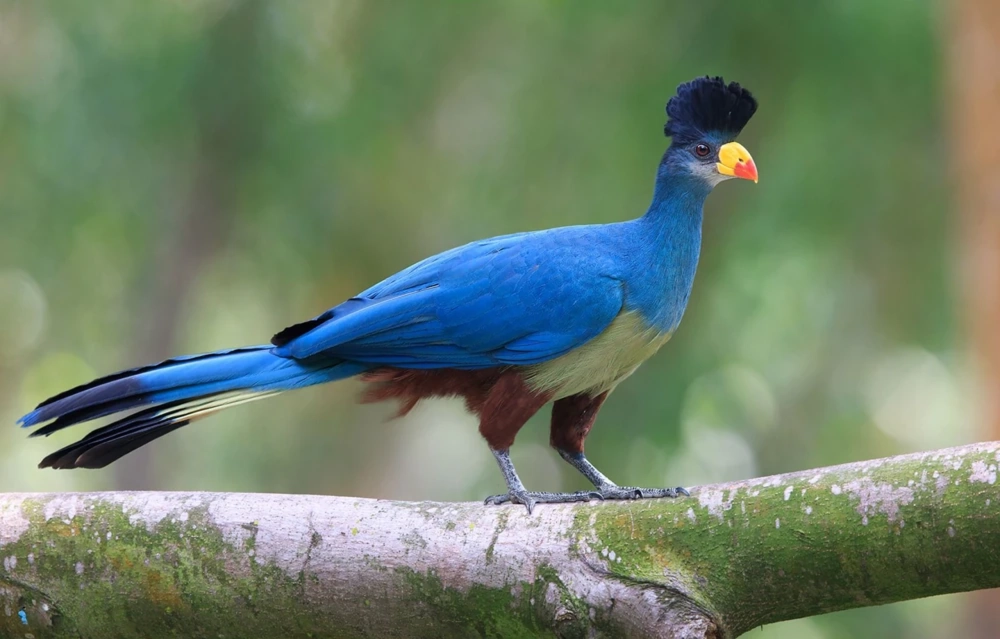
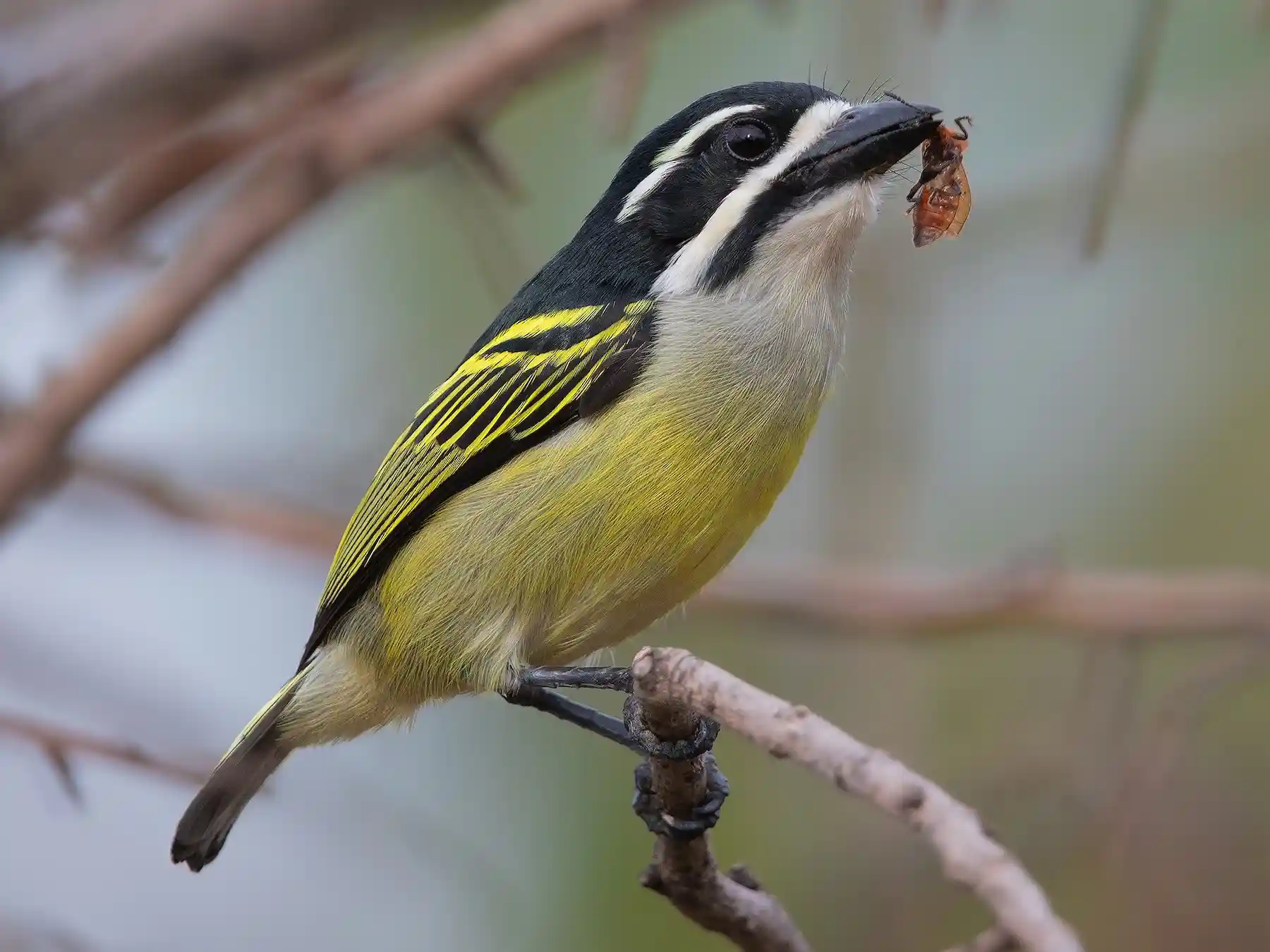
The Royal Mile provides outstanding opportunities to spot an impressive array of species, including Nahan’s Partridge, White-thighed Hornbill, Blue Malkoha, Sabine’s and Cassin’s Spinetail, Blue-throated Roller, Forest and Chestnut-capped Flycatcher, Speckled, Yellow-throated and Yellow-rumped Tinkerbird, Yellow-browed Camaroptera, Lemon-bellied Crombec, Ituri Batis, Tit Hylia, Forest Robin, Narina Trogon, Uganda Woodland Warbler, Grey-throated, Yellow-billed, Yellow-spotted and Hairy-breasted Barbet, Black-billed and Great Blue Turaco, Plain, Spotted, Slender-billed, Little Grey, White-throated and Little Greenbul, Dusky Long-tailed Cuckoo, Chocolate-backed, Blue-breasted and African Dwarf Kingfisher, Black-capped Apalis, and Red-tailed Bristlebill, among many others.
In addition to birds, the Royal Mile is rich in primate life. Species commonly encountered include Red-tailed and Blue Monkeys, Olive Baboons, and Black-and-white Colobus (Guereza), with the occasional chance sighting of a Chimpanzee. Smaller mammals such as Red-legged Sun Squirrel and Boehm’s Bush Squirrel further enhance the wildlife experience.
2. Kaniyo Pabidi Ecotourism Site
While the Royal Mile offers grand vistas, the Kaniyo Pabidi sector—located near the entrance to Murchison Falls National Park—offers a more intimate encounter with the forest floor.Kaniyo Pabidi is famous for its habituated chimpanzees, but for those with binoculars around their necks, the real prize is the Puvel’s Illadopsis. This shy, terrestrial bird is found nowhere else in East Africa.
It spends its days foraging in the leaf litter, and finding one requires a mix of patience, silence, and the expert ears of a local guide. As you trek through the shadows of Kaniyo Pabidi, you may also encounter the Fire-crested Alethe, the Blue-breasted Kingfisher, and the rare Nahan’s Francolin, a species currently classified as endangered and a top priority for global conservationists.
3. Busingiro Ecotourism Site
Busingiro serves as the vital administrative gateway to the Royal Mile and a rich educational hub for those exploring the southern reaches of Budongo Forest outside the national park boundaries.
While it no longer serves as the primary site for chimpanzee tracking, it remains a hotspot for specialized birding and botanical exploration, featuring a well-curated Information Center that highlights the forest’s medicinal plants and unique mahogany ecology.
The trails radiating from the center are particularly productive for spotting canopy-dwellers like the Lemon-bellied Crombec, Crested Malimbe, and various brilliant sunbird species that are often more accessible here than in the denser forest interior. It is an essential stop for visitors to engage with local conservation history, offering a peaceful setting for forest walks that showcase Budongo’s immense butterfly diversity and ancient Warburgia trees.
Iconic and Special Birds in Budongo Forest
Budongo Forest Reserve is a critical ornithological sanctuary, distinguished by its unique ability to host species found nowhere else in the region.
The Budongo Exclusives
Budongo is the only location in East Africa where you can find these two highly sought-after species:
- Yellow-footed Flycatcher: Usually spotted high in the mahogany canopy along the Royal Mile.
- Puvel’s Illadopsis: A shy, ground-dwelling specialist found in the dense undergrowth of the Kaniyo Pabidi area.
Forest Kingfishers
The forest is renowned for its diversity of kingfishers, many of which are forest-dependent rather than water-dependent:
- Chocolate-backed Kingfisher: A stunning canopy dweller often heard before it is seen.
- Blue-breasted Kingfisher: Frequently found in the mid-strata of the forest.
- African Dwarf & African Pygmy Kingfishers: Two of the smallest and most vibrant insect-eating kingfishers in Africa.
Hornbills & Large Forest Birds
The soundscape of Budongo is dominated by the prehistoric calls of these massive birds:
- White-thighed Hornbill: A rare forest giant with a distinctively large, pale casque.
- Piping & Black-and-white-casqued Hornbills: Commonly seen gliding between fruiting trees.
- Great Blue Turaco: A massive, colorful bird often seen leaping through the branches in the early morning.
Sought-After Rarities
For serious birders, Budongo remains one of the few reliable sites for these elusive species:
- Nahan’s Partridge (Francolin): An endangered, ground-dwelling species that requires careful tracking.
- Ituri Batis: A localized specialist restricted to specific forest types.
- Lemon-bellied Crombec: Often found flitting through the high canopy.
- Black-eared Ground Thrush: One of the forest’s most difficult and rewarding finds.
Aerial Specialists
Look to the gaps in the canopy and the sky above the Royal Mile for these powerful fliers:
- Cassin’s Spinetail: A high-speed aerialist that often drinks from forest pools on the wing.
- African Crowned Eagle: Africa’s most powerful eagle, frequently seen soaring above the forest in search of monkeys.
Best time for birding in Budongo Forest
Birding in Budongo Forest is rewarding throughout the year, but certain seasons offer optimal conditions and enhanced sightings. The prime birding period runs from June to September, when the forest enters its main fruiting season. During this time, food is plentiful, bird activity is high, and many species display vibrant breeding plumage, making identification easier and sightings more frequent.
A secondary good period is December to February, which coincides with the driest months of the year. Reduced rainfall means better road access, firmer forest trails, and longer, more comfortable birding walks. Although migratory birds are not the primary attraction in Budongo, Palearctic migrants are present from November to April, adding diversity to the species list.
The least favorable months are April to May and September to October, when heavy rains can make access roads muddy or impassable and forest trails slippery, potentially limiting birding time. However, even during the wet season, the forest remains productive for experienced birders willing to adapt to conditions.
Practical Information
Permits and Fees
- Bird Watching: A specialized birding permit costs approximately $40 per person per day.
- Chimpanzee Trekking: Standard treks at Kaniyo Pabidi are priced at $130 for foreign non-residents, which includes guide fees.
- Park Entry: If birding specifically at Kaniyo Pabidi, you must pay the Murchison Falls National Park entry fee, which is currently $45 per person per 24-hour period.
Accommodation
- Pabid Lodge: Located on-site at Kaniyo Pabidi, which is currently under construction is set to offer an extraordinary blend of luxury and adventure. With 10 luxury tented rooms to start – 8 standard size, 1 larger room, and 1 honeymoon suite.
- Masindi Hotel: A historic colonial-era hotel in Masindi town, about 45 minutes from the Royal Mile.
- Murchison Falls Lodges: Great options like Paraa Safari Lodge and Murchison River Lodge are accessible if you are combining birding with a traditional game safari.
Essential Gear
- Optics: High-quality 8×42 or 10×42 binoculars are vital. Because the mahogany canopy is exceptionally high (up to 80m), a spotting scope is strongly recommended for the Royal Mile to identify small canopy specialists like Batises and Crombecs.
- Clothing: Wear long-sleeved shirts and trousers to protect against stinging nettles and insects. Neutral colors (green, khaki, or brown) are best for blending into the forest.
- Footwear: Waterproof hiking boots with good grip are essential, as the forest floor can be muddy even during the dry season.
- Field Guide: The Birds of East Africa by Terry Stevenson and John Fanshawe remains the definitive guide for the region.
Access and Transport
- Location: Budongo is roughly a 4 to 5-hour drive from Kampala via the Gulu highway.
- Internal Transport: A 4WD vehicle is necessary, especially for the access road leading to the Busingiro sector and the Royal Mile, which can become challenging after heavy rains.
- Guides: Engaging a specialized site guide is highly recommended; their knowledge of the specific “calls” and “stakes” (regular perches) for rare species like the Nahan’s Partridge is invaluable for a successful trip.