
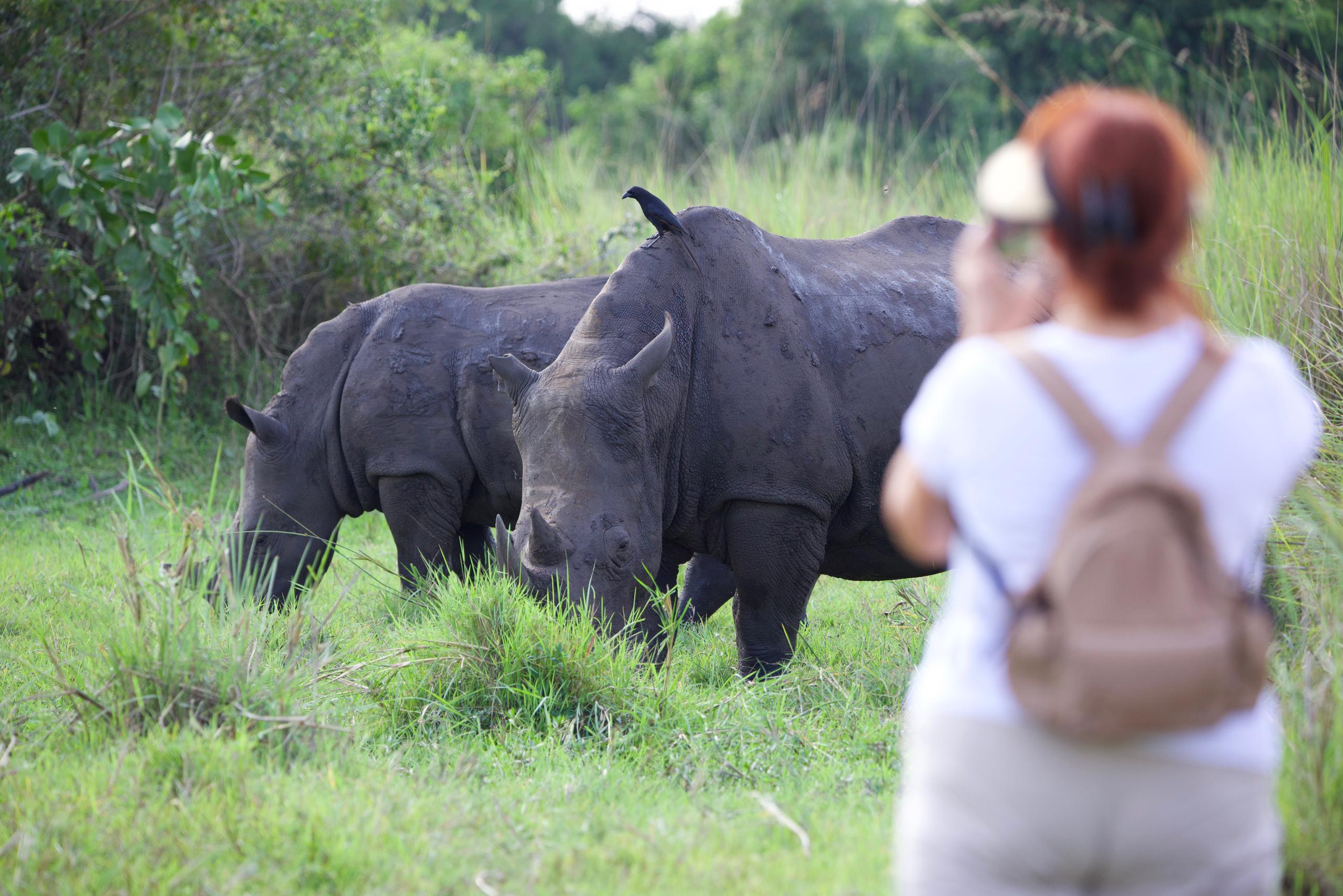
The rhinoceros is perhaps the most fascinating member of the Big Five. In Uganda, you can see these magnificent animals in the wild exclusively at Ziwa Rhino and Wildlife Ranch—also known as the Ziwa Rhino Sanctuary. This is the only place in the country where rhinos roam freely under careful protection. Your visit begins with a ranger-led safari. You’ll start the journey by vehicle, driving through the sanctuary’s scenic landscapes. As you approach the rhinos, the adventure continues on foot, allowing you to get incredibly close—sometimes just a few meters away—for an unforgettable encounter.
Ziwa Rhino and Wildlife Ranch is located in Nakasongola District, roughly 176 km (109 miles) north of Kampala, Uganda’s capital. The drive takes about three hours, making it a convenient and popular stop for travelers heading to or returning from Murchison Falls National Park. Access is easy by car: simply branch off the Kampala-Gulu highway at Nakitoma Trading Center. Visiting Ziwa is not only a thrilling wildlife experience—it’s also a meaningful way to support rhino conservation in Uganda.
The Story of Rhinos in Uganda
Not long ago, Uganda was home to both black and northern white rhinoceroses.
By the early 1980s, however, the country’s native rhino populations – once estimated at around 700 – had been nearly wiped out. Political turmoil under the dictatorship of Idi Amin, combined with poaching for their valuable horns, decimated these majestic animals.
More than a decade later, a bold conservation initiative aimed to bring rhinos back to Uganda. Rhino Fund Uganda identified Ziwa Cattle Ranch as a prime habitat for reintroduction and approached its owner, Captain Joseph Charles Roy, a former pilot and devoted animal lover. They proposed that he relocate the cattle to make way for rhinos. Inspired by the vision, Roy agreed, and in 2005 and 2006, six southern white rhinos were brought to the ranch – four overland from Kenya and two flown from Disney’s Animal Kingdom in Florida on Roy’s own cargo airline.
The results exceeded all expectations. While the team had anticipated that Ziwa’s mix of swamps, savannah, and woodlands would provide a suitable home, they did not foresee the scale of success. Today, Ziwa is home to 48 rhinos.
Ziwa Rhino and Wildlife Ranch is now managed by the Uganda Wildlife Authority (UWA). The ranch features lodges for tourists and offers walking safaris to see rhinos, shoebills, leopards, antelopes, warthogs, and other wildlife. Revenue generated supports rhino conservation directly.
Rangers at Ziwa provide round-the-clock protection.
Each rhino family is monitored by at least two wardens, while additional rangers patrol the ranch’s perimeter. This rigorous security deters poachers seeking rhino horns, while also allowing wardens to collect detailed behavioral data. These insights are invaluable, contributing not only to the survival of Uganda’s rhinos but also to global rhino conservation efforts.
Walking to the rhinos
The highlight of a visit to Ziwa Rhino and Wildlife Ranch is undoubtedly the rhino trekking experience. Few places in Africa allow visitors to get this close to these endangered giants, and on foot no less—a rare opportunity that makes every step unforgettable.
Upon arrival at the sanctuary’s headquarters, guests receive a safety briefing from a team of highly trained, armed rangers. Because rhinos roam freely across the expansive ranch, visitors are often driven closer to their current location in a vehicle—either their own or one provided by the ranch—before continuing on foot through the bush.
The trek usually lasts 1.5 to 2.5 hours, depending on how far the rhinos have wandered that day.
Along the way, guides share fascinating insights into rhino behavior, the individual stories of each rhino (many of them named and well-known), and the ongoing challenges of conservation. One memorable example is the sanctuary’s famous baby “Obama”, the first calf born at Ziwa in 2009 to a Kenyan father and American mother.
Seeing a rhino up close is awe-inspiring. Adult males can weigh over 2,000 kilos, and yet despite their enormous size, there’s a gentle vulnerability in their eyes that leaves a lasting impression. You see both a powerful, magnificent creature and a delicate, endangered species in need of protection. It’s an encounter that is as moving as it is thrilling—an experience that stays with you long after the walk ends.
Key Details for Visitors
Safety First: Rhinos are incredibly powerful animals, weighing up to 2 tonnes (over 350 stone) and capable of running faster than most humans. For your safety—and theirs—visitors must strictly follow all instructions from the expert guides, who are on duty 24/7 to protect both guests and the rhinos, while also preventing poaching.
Optimal Timing: While visits are available throughout the day, the best times to see the rhinos are early morning (7:00 am – 10:00 am) and late afternoon (4:00 pm – 6:00 pm). During these cooler hours, the rhinos are most active, often grazing or gathered near watering holes—perfect for spotting and photographing them.
What to Pack: Comfort and safety are key. Visitors should wear sturdy, closed walking shoes and long pants to protect against thorns and insects. Bring essentials like drinking water, insect repellent, sun protection, and a camera with ample memory for capturing close-up shots. Rhino trekking is family-friendly, and children aged six and above are welcome to join.
Beyond the Rhinos: More to Explore at Ziwa
Ziwa Rhino and Wildlife Ranch offers more than remarkable rhino encounters. The sanctuary is a thriving ecosystem, home to over 40 species of mammals, including Uganda kobs, oribis, waterbucks, bushbucks, monkeys, hippos, and crocodiles. For bird lovers, Ziwa is nothing short of extraordinary, with over 350 recorded bird species—the star attraction being the elusive, prehistoric-looking shoebill stork. One of Ziwa’s most sought-after experiences, this guided trek and peaceful canoe ride through the Lugogo Swamp offers the best chance of spotting the rare shoebill stork in its natural habitat.
For those wishing to stay longer, Ziwa offers a range of accommodation options to suit every traveler. Choices range from budget-friendly rooms and campsites to comfortable mid-range lodges and luxury stays such as Amuka Safari Lodge. Accommodations feature amenities like a restaurant, bar, and sometimes a swimming pool—ensuring your stay is both relaxing and memorable.
A Must-Visit Destination
Visiting the Ziwa Rhino and Wildlife Ranch is more than just a tourist activity; it’s a chance to witness a remarkable conservation story in action and contribute to the effort to bring rhinos back from the brink of extinction in Uganda. Located conveniently en route to Murchison Falls National Park, it offers a perfect opportunity to complete the “Big Five” safari experience and make a meaningful connection with Africa’s incredible wildlife heritage.
Want to read more in preparation for your trip to Uganda? We regularly write blogs to help you get started.
